Showing posts with label Guy Carbonneau. Show all posts

Friday, November 28, 2008

Carbonneau Sets A Soft Tone

I don't get it! I don't understand why a coach who has just seen his club play its best game of the season two nights earlier frigs with the mentality of his team's fragile psyche by starting his backup goalie in what could have been considered a "gimme game''.

It was repeated over and again and nauseum that the Washington Capitals were missing four starting blueliners and three forwards from their regular roster.

It was a perfect opportunity for coach Carbonneau to infer that you should never take an opponant lightly, start Carey Price as usual, and go for the kill. Keep the flow of momentum building from a strong team win.

But no...what does he do, he lowers the entire guard of the team by playing Jaroslav Halak instead, thus informing the boys that this is in fact a night off. An easy one. Two points bagged at the puck drop.

If one chooses not to believe that players actually think this way, the proof was in the pudding served up tonight. Just look at the results speaking for themselves. In preparing for a game, knowing that the backup is playing, the easy game mindset creeps in slowly but surely. It is especially stupid for a coach to announce which goalie will play two or three games before.

In my thinking, if a coach wants all concerned to be on the attentive, it would be a good policy to simply not announce the starting goalie at all. Keep the players on their tip toes and make the decision just prior to the pre game warmup.

All of this has little to do with what goalie Halak is capable of. He's a decent puck stopper, nothing more and nothing less. But if one chooses to believe Halak is the future tender of the franchise, you are sadly mistaken and misinformed.

Price is the guy. The undisputed number one who should only ever sit when the Habs play non playoff bound teams outside their division. A smart coach lets the standings dictate when a goalie plays and not the schedule. Price should play all games against Northeast division rivals, and all playoff bound teams in the conference. Halak starts against the Atlanta's, Islanders, Panthers and Lightning and their ilk.


The Capitals lineup includes the NHL's best player in Alexander Ovechkin - enough said!

Come playoff time, Price might face him in up to seven games, so it is crucial that he gets to oppose Ovechkin as often as possible. The Canadiens gain nothing in having Halak face the NHL's best sniper.

That's no brainer number one.

Goalies, it is often said, get on a roll after a strong performance. When they are hot - and Price has been in a zone - they should be played in between 7 and 9 games running. Sit Price when it shows he's tiring not before it.

Call that no brainer number two.

Carbonneau often rolls the double spins of the two games in two nights, and the backup has to play to remain fresh schpiel, but it's a crock of shit as far as I am concerned. Goalies - especially hot ones - can handle two games in two nights. If they cannot, goalie management won't camouflage the issue, no matter how creative the spin.

No brainer number three.

Now imagine the players on the Capitals knowing two days in advance that there are facing Halak instead of Price. What runs through their heads is akin to, "So this is what Montreal thinks of us, eh? We'll show them!" How would you react once you've felt you've been underestimated?

That's the fourth no brainer.


Again, all this is only about the perception behind the reasoning of starting Halak, and not a knock against him. Had the entire Habs team shown up to play, he would have won the game.

As is often the case with Carbonneau and his coaching decisions, I am usually able to resolve myself by seeing some fairness in a counter argument, but this time, I got nothing. Because I have seen this happen time and again before, his decision to go with Halak bugged me since the moment it was announced. maybe you saw this mess of a concerted effort by the Canadiens coming as well.

What irritates me to an even larger ass rash, is that the coach as team psychologist, ought to have his pulse finely tuned to the temperment of the team. He's got to know how they'll react to things before they have that chance to react. Coaches get out of tune by sweeping such concerns under the carpet after a while. If a coach does it often enough, the team starts trusting the actions he speaks more than his warning words.

The message Carbonneau ought to have sent out should have been, "Price is playing. The Capitals are a strong club and we will need our best to be at their best to win this one."

What he did in essence, is the exact opposite.

The Canadiens have just passed the quarter mark of their 2008-09 season. So far the club has coasted to an acceptable record based on the skill on the team. Admittedly, they've pulled a few irons from the fire to get the record they own, but there are two prime issues that have dogged them since game one.

For starters, the players are not gelling as they have in the past. With the Detroit win, they finally displayed some cohesive team unity. Secondly, there seems to almost be an underlying theme of overconfidence when it comes to facing rivals that ought to be easy meat. The Canadiens approach these games like they are already won. It's a big mistake that even the best teams in the league are sometimes prone to.

As I pound this out on the keys, Carbonneau is likely claiming to a random microphone that he can't fathom why his club failed to show for the game. He might malign a certain lack of leadership from some factions.

My question begging an answer is, "aren't the coaches the most important of leaders?"

Carbonneau got exactly the game he ordered tonight.

Photos courtesy of the Montreal Gazette / Habs Inside Out

.

Friday, November 21, 2008

33 Things You Might Not Know About Patrick Roy

Aside from holding numerous goaltending records and counting for some momumental achievements in hockey, Patrick Roy's career has had it's share of interesting moments away from the limelight. Here are 33 lesser known facts and trivial details about Roy's career in hockey.

1 - Mario Lemieux and Patrick Roy not only faced each other in junior, they were in fact born on the same day - October 5, 1965.

2 - Roy's father Michel, and his mother Barbara, were both athletes in their youth. The father toiled some in hockey, but was mainly involved with tennis. His mother was an Olympic swimming hopeful, named after Barbara Ann Scott. Patrick's brother Stephane had a brief NHL career with the Minnesota North Stars.

3 - Patrick's first strides on the ice came on former Canadiens player Leo Bourgeault's (1932-35) backyard rink in Ste Foy.

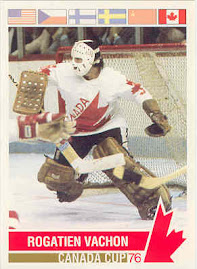
4 - Daniel Bouchard of the Nordiques and Rogatien Vachon of the Kings were Roy's first goalie idols as a young boy. In the first NHL game his father brought him to, he got to watch Rogie in action against the Canadiens. Bouchard later gave him a stick, that Patrick was known to sleep with for luck, and a hockey card that he always kept carefully placed in his locker. Roy couldn't resist the temptation, and the stick was used in games as a 16 year old with St. Foy.

5 - At age 9, Roy and two Atom team mates were asked to participate in a shootout in front of fans at the Collisee in Quebec. The Nordiques were hosting the Chicago Cougars, whose assistant coach was Jacques Demers. Roy stopped 4 of 6 shots he faced.

6 - At the 1976 Quebec International Pee Wee tournament, Roy helped his team go three rounds deep despite the loss of their leading goal scorer. During the tournament, Roy had his photo taken with a 12 year old Brett Hull.

7 - When he was fourteen, his father gave him a set of 1951-52 Parkhurst hockey cards, and it set him on the road to becoming an avid collector. He still owns the Parkie set featuring the Beliveau and Rocket Richard rookie cards, and his collection has grown to include over a 100,000 individual pieces.

8 - At 16, while playing for the Midget AAA St. Foy Gouverneurs, Roy brought his team to the league title and the the final game of the Air Canada Cup in Victoria. Along the playoff route, he was suspended three games for shoving an official after a disputed goal involving a gloved pass. Roy returned to lead his club to the Canadian midget finals, only to be undone by Burnaby's Cliff Ronning.

9 - Roy's father Michel claims that his son has a photographic memory. During the hearing for the suspension mentioned above, Roy retold exactly where everyone stood and where the puck lie during the incident. He not only was able to name each person and what they were doing, he was able to account for what each person was able to see. His perception of detail also extends to statistical data, such as player stats and hockey card trivia.

10 - There's something to be said for a good goalie on a bad team progressing quicker than a goalie on a good team. All during Roy's development, straight through to Granby in the QMJHL, Patrick played mainly on clubs where he was peppered with shots.

11 - The Canadiens scouts noticed Roy on a trip to Granby to have a look at Stephane Richer. During the game, Granby were killing off a 5 on 3, when three players broke in alone on Roy. After stopping the first two, Roy threw the puck at the third player, gesturing him to give it his best shot. That summer, Montreal drafted both Roy and Richer.

12 - The Canadiens drafted Roy with the third round pick received from trading defenseman Robert Picard to Winnipeg in 1983. Curiously, the Habs had acquired Picard from the Toronto Maple Leafs for goalie Michel "Bunny" Larocque.


13 - In his initial training camp with Montreal in 1984, he was given the number 32. The following season, Roy asked for number 33, but was again handed 32. When Montreal decided to leave Richard Sevigny unsigned, Patrick finally got his wish.

14 - Roy got his chance with the Sherbrooke Canadiens following the end of his regular season in Granby when the baby Habs backup goalie Paul Pageau asked to leave the club to attend his wife's pregnancy. When Sherbrooke's starter Rick Moffat went down to injury, coach Pierre Creamer gave the net to Roy, who had played inonly one regular season game. Roy won the first playoff start, and the rest is history.

15 - Throughout his junior career in Granby, Patrick never won a individual award or placed on an All Star team. Contrary to popular belief, he did not win the most valuable player award with the Sherbrooke Canadiens in their 1985 Calder Cup win. That merit went to Brian Skrudland. The first major individual award earned by Roy was the 1986 Conn Smythe trophy. Not a bad place to start!

16 - Roy appeared in his first NHL game on March 1, 1985 against Winnipeg, and he had current Canadiens coach Guy Carbooneau to thank for it. Patrick was called up in late February from Granby to replace starter Steve Penney, who suffered an injured groin on a shot by Carbonneau. Backup Doug Soetaert was replaced after two periods and Roy made his debut, stopping the only two shots he faced to earn the win.

17 - Upon signing his first contract with the Canadiens, Roy did like most players and went out and purchased his first brand new car. Strolling cockily into a Honda dealership, Patrick spotted the car he wanted and announced to the salesman that he was ready to buy it. The salesman, not recognizing him from Adam, tried to shrug Roy off as just some cocky kid, telling him he couldn't afford the payments. When Roy proclaimed he was prepared to pay cash for expensive (at the time) Prelude, the salesman got serious. The deal was done so hastily by the anxious pair, that Roy's new Honda ran out of gas at the bottom of the first hill he met.

18 - The "Casseau" nickname came from Roy's constant diet of french fries when he made the club in 1985. "Casseau" is the french word for the box holding the chips that seemed to constantly accompany Patrick's meal. Team dieticians and conditioning experts made certain the habit was not long lasting. A Conn Smythe trophy win rebaptized him Saint Patrick for good.

19 - Roy's first NHL start came on October 10, 1985 in Pittsburgh on opening night of the season. He was given the start over vets Soeteart and Penney, and made 23 saves for his second career win.

20 - One his way to winning the Stanley Cup and becoming the youngest ever winner of the Conn Smythe trophy in 1986, fans and media became fascinated with Roy's ritual of superstitions. Beyond holding conversations with his goalpsosts, Roy never skated accross the blue or red line, wrote the names of his children on his stick, kept all the pucks from his shutouts in his locker until seasons end, and used or wore the same equipement for game's on end during winning streaks. By his second Cup and Smythe in 1993, Roy had shed practically all of his eccentricacies.

21 - Patrick's impersonation of axe wielding Ron Hextall cost him eight games during the 1987-88 campaign. In a game on October 19, Roy became annoyed at constantly being bumped and shoved by the North Stars Warren Babe. He then took it upon himself to deliver a two handed paddle whack to Babe's ankle during a scuffle between the Habs John Kordic and Richard Zemlack of Minnesota. When Roy returned to action on November 14, he did it with panache, shuting out the Blackhawks 3-0.

22 - It has often been an opinion that Brian Hayward was the best goaltending partner Roy ever had. Behind the scenes, the pair shared an uncomfortable coexistance. Room mates on the road, Roy often felt that Hayward was trying to sabbotage his starts by partying long and loud the night before.

23 - From the 1988 season until October 16, 1989, Roy had a 35 game unbeaten streak on Forum ice. Dale Hunter of the Nordiques ended the run with overtime goal on that date.

24 - Coach Pat Burns once fined Roy for sleeping in and missing a practice in 1989. The goalie blamed his infant son Jonathan for knocking a phone off the hook that was to bring his wake up call.

25 - Roy suffered few injuries during his career, but he was unfortunate in the early 1990's. In December of that year, the Maple Leafs' Wendel Clark shoved a tumbling Petr Svoboda over Roy, causing him to sprain a medial collateral ligament in his leg. He returned three weeks later to shut out Calgary in his first game back. The following season, he tore ligaments in his left ankle when he ventured out to play a stray puck and became sandwiched in a Graeme Townsend - Donald Dufresne collision. He'd miss part of the 1991-92 season, when the injury was reaggrivated.

26 - When Roy won his second Cup with Montreal in 1993, he and the club set an NHL record that will be near impossible to match by winning 10 consecutive overtime games. In the process the team tied the record for most wins in a row with 11, while Roy became only the second player to earn two Conn Smythe trophies.

27 - Roy played the entire 1993 playoffs with an illegal width goalie stick. (Just kidding!)

28 - After Game 2 of the 1994 playoffs, Roy suffered an emergency appendectamy that caused him to miss game three of the first round against the Bruins. Returning victorious for a game 4 win, an exhuberant hospital attendant claimed to have the actual removed appendix from Roy, and attempted to auction it off.

29 - With relations between Roy, certain team mates, and management sourring in the fall of 1995, general manager Serge Savard had a deal on the table to send him to Colorado when the season began. Savard hesitated to make the move, hoping things would smooth over, but was fired shortly thereafter. The trade would have brought goalie Stephane Fiset and forwards Owen Nolan and Adam Deadmarsh to Montreal.

30 - When Mario Tremblay was first announced as the Canadiens coach replacing Jacques Demers, it caught Patrick offguard and in an uncomfortable way. Someone in the Montreal media mentioned Roy laughing, and it didn't help appease what would turn into a volcanic relationship not long after. Roy explained his giggles by proclaiming that since Tremblay was a former team mate, his signing made him feel old. Tremblay's first words to Patrick were, "You stop the pucks, I'll coach!"

31 - Not long after becoming a member of the Avalanche, Roy represented the club in the 1996 All Star game. Joel Quenneville, then an assistant with Colorado, joined in on a card game with Roy, Ray Bourque and others on a plane trip to the game. In the middle of playing hands, Roy told Quenneville, ''You know Joel, we're going to win the Cup this year.'' The coach, unsure of what he's just heard, says "What?", to which Roy repeats himself, without adding a word of explanation. The Avalanche won the Cup five months later.

32- After Patrick had played in his 1000th career game, the Avalanche celebrated the event by gifting Roy with several tokens of appreciation. The NHL kicked in with the now standard silver stick, but it was the presenter who Roy appreciated the most. Along with his Cup wins, Roy always mentions that meeting Rogie Vachon on this special night would long hold a place in his heart.

33 - Roy had many off ice indiscretions by the time he retired, few of them helping his public image. Lesser known was his kindness away from the lights, bringing kids onto the ice after practices to take shots on him. One particular time, Roy played along with a youngster, letting him score on every rush the whole time he was out there with the legend.


.

Tuesday, November 18, 2008

Removal Of Kovalev As Power Play Focal Point The Key To Recreating It

The formerly top ranked Canadiens powerplay has gone AWOL, and rectifying it is a top priority for the team in trying to get back on track and refind it's consistent winning ways.

The Canadiens PP currently sits 25th in the NHL, having counted on only 12 of 82 opportunities thus far for a conversion ratio of 14.6%. Only the Blue Jackets, Coyotes, Panthers, Devils, and Islanders are faring worse.

In assessing what is not working at present, it is important to understand the reasons behind the unit's lack of success so far.

What is difficult to breakdown, is that Montreal certainly have enough offensive elements to succeed with a man advantage, at first glance. All the keys seems in place, with a nice mix of snipers, forwards strong on the puck in corner board battles, some good sized options in front of the net, and good puck movement from the point. So far, the units used have created enough chances to merit continued patience and faith, but without results both will wear thin.

In past seasons, isolating the prime ingredients for the Canadiens power play success was a simpler matter. In 2006-07, Sheldon Souray's blasts from the blue line were a constant threat. Two reasons accounted for Souray's success: no one dared get in the way of the quickly unleashed bullets, and the shot was most often highly accurate.

In 2007-08, a Souray - lite in Mark Streit manned the point, and while his shots were nowhere near Souray's in velocity, they were accurate and low, and efficiently dispensed. Streit was equally adept at moving the puck as swiftly as he shot it, and that enabled the other shooters big gains.

With either of Souray and Streit, the opposition was kept off guard and guessing due to the varying options, and that was how the Canadiens capitalized most often.

Perhaps misunderstood most in these schemes during this time, was the role of Alex Kovalev on the right side. Other than the changing faces at the point, he is the one of two constants on the first unit. His role is essentially to quarterback the powerplay from the right board out, and it is his work that other teams have keyed on and adjusted to most swiftly this season.

Earlier in the season, the Canadiens sought to employ it's other first unit constant, Andrei Markov, in much the same manner as Streit was worked last year. By moving Markov over to Kovalev's side of the ice, they figured to capalize on the swift passing between the two to keep the puck in constant motion. Unfortunately for Montreal, Markov was not as comfortable on the opposite side, and his shots at the nets are neither as hard, swift or as accurate as the former foils who played there.

By focusing on Kovalev - essentially double teaming him - the opposition has rammed a spike into the Canadiens power play gears. Truthfully, this is not a new challenge. It began late last season, and became more exposed as the playoffs wore on.

As other teams improved their penalty killing against the Canadiens, they also became less fearful of taking penalties, and thus imposed a more physical standard against the Habs five on five.

What other teams do on the penalty kill is quite basic: they position their four point box openly to form more of a rectangle, with the two closest points aimed directly at Kovalev. With limited space, Kovalev often tries to create options where there are none - flipping passes off the ice where there are no clean lanes, or skating a back and forth "S" pattern to open his end of the box and sneak a shot on goal.

The higher forward closest to Kovalev places his stick in the lane of the pointman, and the defenseman playing him also points his stick toward the blueline, thus negating the cross ice feeds. In this coverage, Kovalev dipsy doodles, circling over his own path in an attempt to open the slightest of spaces and lanes.

Where Kovalev becomes his own worst enemy, is when he attempts longshot plays to create movement on the opposition side. His soft flips to the point fail increasingly, because who ever is playing that position can neither one time a shot, or cradle and move the puck swiftly.

The bigger problem with Kovalev being rendered straightjacketed on the power play, is that it stagnates the four players teamed with him. The forward at the opposite side of the ice, the left wing, almost never sees the puck. The player at the net, or beside it, can only react once Kovalev has shot on goal. That player, the center, must also play the right corner, to allow Kovalev an additional pass option. The defensemen are played tightly enough, just daring Kovalev to risk a fragile pass in that direction.

What results is that the Canadiens players possess the puck for great lengths during their advantage, but the five man unit is almost as immobile as the oppositions defensive setup. When a powerplay does not keep the puck and players moving at all times, it spells disaster.


It must be pointed out that the players involved on the unit are working hard to create opportunities during the ticking seconds. This is not to say the unit isn't working misguidedly. They have tried several tinkerings on the unit to no avail, such as employing a fourth forward - be it Alex Tangauy or Sergei Kostitsyn - on the left point in order to spread out the areas from which the puck can be played, passes can be made, and shots can be taken.

The solution does not lie in the removal of Kovalev per se, but it may require the romoval of him as a focal point. Subtracting the club's most offensively gifted player from the unit is a foolish notion, but reinventing how he works during the advantage is the starting point.

To that end, Kovalev sometimes sets up on left side of the ice, facing the exact same coverage scheme. What differs in this setup, is that his cross ice feeds become less of a risk and his shots on net come from a closer range. His stick is also further away from his opponants, which means he can attempt to move to net more freely to create shots and opening. Where this plan runs into trouble is that Kovalev is not as comfortable with it, and he is still the focal point for the opposition while doing the same things that were not working at his usual space.


Where the Canadiens now stand, is in working against what the opposition regularly throws at them in terms of coverage. The secrets of how to conceal the Habs firepower have been shared league wide, and it is now up to the Canadiens to make the required adjustments to get it moving once more.

Most observers have long believed that placing a larger player in front of the goal is the way to go, but the method in which such a situation works is not always clear. A player seemingly poised on the goaltenders doorstep, screening the view and picking up rebounds is often an illusion. Such a player has to keep himself moving, either from the side of the crease into the goalie's view, or crossing the edge of the crease in order to keep defenseman busy and turning away from the puck focus.

Having a player simply stand on the goalie is akin to nullifying the advantage itself, as his coverage then falls in the hands of the netminder. The four remaining players on the offensive are then covered more tightly man to man, and the extra player the team enjoying the power play has, is now two hundred feet away in their own goal. This setup simply doesn't work as most folks perceive.


What is perhaps doing the Canadiens the biggest diservice at present is the fact that the old methods worked with ease for two plus seasons, and that breaking old habits is hard to do.

After pointing to what has ceased working on the Canadiens power play, one is left to wonder what possibly can unstagnate the efforts of the emn working it. A solution might be to decentralize the Kovalev role in it while maintaining the use of his talents.

To do this, the Canadiens would then employ Kovalev and his passing skills on the blueline. He would only shoot on net when obvious chances presented themselves. Otherwise, he would act only as a simple wheel man in rotating the puck to both sides of the ice with defense partner Markov.

Their passes would have to be brisk, and they would ideally not be holding on to it for long periods of time. They would be advised to move it often and fast in order to tire and frustrate the coverage. They would switch places along the blue line during possession to create options to skate in closer during the crossovers. To facilitate puck movement, their wingers would also be in constant motion, swinging like pendulum points from side to side.

The duo at the blueline would not be played as tightly as Kovalev was by himself before, as it would open all kinds of room nearer to the net. The wingers on both sides would then return as more viable pass and shoot options, and more movement overall would be created. All of both wingers and center could attack the net at given chances, creating more confusion for the opposition.

What a scenario such as this could provide if properly deployed is great deal more room and movement while enjoying the advantage. The keys to any successful power play involve creating space and scoring chances by maintaining puck possession options while moving it fluidly to cause confusion and kaos.

The idea of Kovalev playing the point would return the fluidity to the Canadiens powerplay offense.

The puck and the space to create with it would then become more equally shared amongst the unit's participants. In essence, it would be like giving the players back the skills that have been robbed of them by having Kovalev rule the unit.

The recreation of the power play would not work overnight. Players, especially Kovalev in this instance, would have to get comfortable with the new rigors of it. For one thing, Kovalev would have to learn caution and read inopportunity more precisely. Markov and the remaining players would need time to adjust to receiving passes from angles and areas they have gotten away from. It could take as much as ten games for the unit to become comfortable. By that time it ought to be producing at a better clip that what is currently dying before everyone's eyes.


.

Sunday, November 16, 2008

Once Upon A Time, The Canadiens Made The Blues Legit

The Canadiens are in St. Louis tonight to play the Blues in a rare Sunday night game. Often when the Canadiens and Blues meet, I think back to all the players who have shared both jerseys over the years.

The Blues were once the Canadiens Annex, thanks in no small part to Scotty Bowman, who coached the team in their first three seasons starting in 1967.

When the NHL expanded by six teams that year, the Blues, on Bowman's advice, picked apart the Canadiens minor league teams and built a fairly solid roster very quickly. Bowman knew his stuff, and the Blues made three straight trips to the Stanley Cup final.

With a team loaded with former Habs, the Blues lost to the Canadiens in 1968 and 1969. The following year, St. Louis fell to the heavily favoured Bruins in four games. In fact, when Bobby Orr scored the Cup winner flying through the air, it was a former Hab - Noel Picard - who tripped him!

Early Blues history has the Canadiens written all over them. The Plager brothers, Barclay and Bill, who became legends in St. Louis, were once coached by Bowman in junior when they played for the Canadiens sponsored Peterborough (T.P.T.'s) Petes. Bowman lured some great names from the Canadiens past to play for the Blues during those years, including Jacques Plante, Doug Harvey, Ted Harris, Jean Guy Talbot, and Dickie Moore.

Small wonder the Blues contended so quickly!


Since 1967, sixty-six players, including many former Canadiens, have worn both the bluenote and the CH. Here's an alphabetical listing.

Don Awrey, Murray Baron, Normand Baron, Red Berenson, Bob Berry, Christian Bordeleau, Andre Boudrias, Valeri Bure, Jim Campbell, Guy Carbonneau, Shayne Corson, Bill Collins, Wayne Connelly, J.J. Daigneault, Gilbert Delorme, Rory Fitzpatrick, Ron Flockhart, Dave Gardner, Doug Gilmour, Gaston Gingras, Phil Goyette, Ted Harris, Doug Harvey, Sean Hill, Fran Huck, Pat Hughes, Mark Hunter, Mike Keane, Christian Laflamme, Mike Lalor, Guy Lapointe, Michel Larocque, Claude Larose, Gary Leeman, Chuck Lefley, Jocelyn Lemieux, Bill McCreary, Rick Meagher, Sergio Momesso, Dickie Moore, Phil Myre, Ric Natress, Greg Paslawski, Noel Picard, Jacques Plante, Michel Plasse, Stephane Quintal, Rob Ramage, Stephane Richer, Vincent Riendeau, Phil Roberto, Jimmy Roberts, Bill Root, Martin Rucinski, Glen Sather, Brian Savage, Bill Sutherland, Jean Guy Talbot, Larry Trader, Pierre Turgeon, Perry Turnbull, Ernie Wakely, Rick Wamsley, Eric Weinrich, Doug Wickenheiser, and Rick Wilson.

Additionally, several Habs prospects, such as goalie Ted Ouimet, and prospect Andre " Moose" Dupont, also got their NHL careers rolling in St. Louis, after toilling in the Habs system for years.

In 41 years of games between the Blues and Canadiens, the Habs have owned them big time. The teams have met 118 times, with the Canadiens holding a record of 70-25-22, with one overtime loss.

Here's hoping the dominations continues tonight. The Blues owe us!

Sunday, November 09, 2008

Leafs Hand Habs A Hockey Lesson, And Expose Carbonneau's High Wire Risks In The Process


Raise your hands all those that didn't see this coming!

You in the back with your arms angrily folded, step to the front of the class!

So far this season, the Canadiens are not playing as a focused and cohesive unit. Their 8-2-2 record is not representative of where they are by any means.

After busting out of the gate with a 5-0-1 record to start the season, the Habs have since stunk the joint out by going 3-2-1. Since the seventh game of the present campaign against the Ducks on October 25, they have allowed 22 goals against, while scoring only 19.

The most recent wins against the Wild, the Hurricanes, and the Islanders were almost accidental in nature. In Minnesota, the Canadiens were lucky that the Wild misfired on ten powerplay chances. They needed a shootout to defeat Carolina. Last Saturday, they struggled desperately to come from behind and beat a weak and confidence lacking Islanders club

Last night, the Maple Leafs dealt the Canadiens a lesson in focus, intensity, and hard work. You could also add humility to the growing list.

Cliches in sports have long been invented to explain away what has infested the Canadiens of late.

No game is won before it is played.

Never underestimate an opponant.

Hard work and dedication will beat skill and talent when it doesn't work as hard.

All three of these old adages apply to the loss against the Leafs, and the Canadiens should be feeling quite humbled about now.


The Canadiens showed up to play the same doormat Maple Leafs squad they easily handled 6-1 in the season's second game. The trouble was, that Leafs team was not their opponant last night. Instead, a hungier and more focused club awaited them, and in the final tally, it was the Canadiens who failed to show up and bring with them an equal appetite.

Part of the Canadiens recurring problem is that they know how good they are. Or at least they think they do. A hockey team might be like a rock group, wherein they are only as good as their last record. The last time I checked, the Canadiens haven't won anything of significance recently.

Some of the Canadiens wins at the start of the season weren't pretty either. The Habs have enough talent that they can often turn a game around within minutes. Learning to rely on that fact is a catastrophic recipe for disaster. The come from behind win against the Islanders, and even the late goal against the Blue Jackets the night before that allowed the team a point in a loss, tends to fuel the notion that they can pull irons out of the fire at anytime.

Last night provided another example. With Toronto ahead by two goals, the Canadiens profited from the Leafs indiscipline by notching a pair of goals on the power play to tie the game. I gather such only served to bolster their overconfidence. What they failed to grasp was that Toronto handed them the opportunities, the Canadiens did not earn them with hard work.

Three successive calls in the Leafs offensive zone, all three for running the goaltender, opened the Canadiens window. It was not the Habs thrusting in the Leafs zone that fed their chances. Once the Canadiens had evened the score, it was as if a forthcoming win was taken for granted.

What disgusts me most, is that even by that time of the game, the Habs had yet to seize that their opponant was their equal.

It should be drilled into this team's collective consciousness that the Toronto Maple Leafs are always going to be a formidable foe, irregardless of what they appear to be on paper, or what their current record is, or how they have played in recent games. The Maple Leafs live, exist, and yearn to eat the Habs alive, especially in a perceived underdog's role.


The Canadiens approached last night's game as though it had already been won on paper.

But why on God's earth would the Habs think they were in for an easy night against Toronto. The Leafs have beaten the Red Wings, Bruins, Senators, Devils, Rangers, and now the Canadiens so far this term - not a sad sack team in the lot. Coach Ron Wilson is the big difference maker. He has his team poised every game, and playing with a do or die edge.

I'd like to see such a temperment instilled into the Canadiens players!

Perhaps the Canadiens are subscribed into the illusions and distractions brought on by the perceptions of themselves by fans and media. In a celebratory one hundredth season, it isn't unlikely.

Maybe it is because there has been no shortage of excuses to pamper their failures game in and game out, even when they win ugly.

It could be that coach Carbonneau isn't hard enough on the team. I see unflaged accountability issues everywhere I look on this team, yet the team's slow start in games is most often blamed on a schedule that gives them too many successive nights off. What a load of crock!

I like Guy Carbonneau as a coach, but sometimes he could be accused of tiptoeing around things when a hammer ought to be employed a bit more liberally. Most of the Canadiens players this season are doing all kinds of good things on the ice, yet their errors seem to be swept under a collective carpet of absent denial.

These issues do not go away by themselves. They need to be confronted head on.

On ice indiscipline on this team is a recurring issue. Two seasons ago, when Carbonneau was a rookie coach, I could understand that calming such habits was a work in progress. Last season it seemed to be dealt with, but it has made a return this season.

When a former players such as Carbonneau become bench bosses, their disrespect for the game's officials follows them. I'm not privy to Carbonneau's words in the heat of action, but his gestures, mannerisms, and consistent facial smirks speak loudly enough to broadcast his opinions.

Players pick up on such vibes, and the attitude becomes contagious. A coach needs to mute such disgust to unseen and unheard proportions, because it affects his players perceptions greatly. Bad officiating gives all players an excuse, and an out, when a coach publically displays a vivid displeasure on controvercial calls. The next bad penalty they take, will always be the referee's fault, in that line of thinking. Trouble often begins when accountability goes off compass.


There's another old sports cliche, mostly passed among coaches: Give players an obvious excuse, and they will run with it everytime.It is the nature of the blamed. A coach who is a former player of 20 NHL seasons ought to know this much, and learn to control his every reflex towards that. He's only passing along bad habits if he doesn't reel the instinct in.

Another Carbonneau goof came at the term of training camp, when he was discussing the composition of the teams individual lines and their roles on the club, In boasting of the Habs apparent offensive gunpowder, Carbonneau publically stated that there was no particular trio of the four whose role was mainly to act in a defensive mode.

All four lines had scoring punch, according to the coach, and all four lines would also be tasked with both offensive and defensive responsabilities. To that end, and with an eye on not damaging any egos, the coach also added that the club had no defined number one line as well.

Twelve games into the season, those proclamations may have served to cause the Canadiens current strife.

Roles need to be defined and underlined specifically on a team. Tasks need to be outlined and detailed to precision without fail. Barring such understood definitions creates a finger pointing atmosphere amongst the team, where players blame others without a word being said rather than take responsability for breakdowns themselves.

Ignoring all of this is a recipe for a rot that can eat at a team's core - witness the Ottawa Senators 15 games into the 2006-07 season for an example of this.

Added all up, the Canadiens are an indisciplined team, skilled but over confident, ill prepared for what is at stake in each game, and unaware of forthcoming consequences. It is becoming obvious enough after only 12 games that other teams are learning how to prey upon such cracks in the foundation.

A redefinition of the team is required in order for the Canadiens to carve out an identity that suits their ultimate goals.

It all starts at the top, with corrections made by those who call the shots.


.

Friday, October 10, 2008

Habs Begin New Season Looking For A Difference


In 2007-08, the Montreal Canadiens were the surprise team of the NHL - by a longshot!

Such a surprise cannot happen a second year running, as teams will be better prepared to face the Canadiens this time around.

With such a notion in mind, the Canadiens were busy tinkering with their powerplay over the last few practice sessions, trying to remain a step ahead of the adjusting competition.

It might seem odd to some, that the Habs would be focusing on the one perceived part of their game that is unquestionably not broken. The old adage of "why fix it if it ain't broke" must have crossed many a hockey mind upon learning of this. I know that it did mine.

What the Canadiens have been doing, is moving elements of the powerplay unit around in order to find ways to adjust to opponants having figured out how to stiffle the Habs deadliest of weapons.

Assistant coach Doug Jarvis, a former defensive specialist who guides the club's powerplay, is not trying to reinvent the wheel, but merely seeking to keep it round and rolling.


During last season's playoffs, Boston and Philadelphia, due to a growing familiarity with what players such as Andrei Markov and Alex Kovalev bring do best, began to shut down their passing lanes and play both men much tighter.

The result was significant enough for the Canadiens to look into ways of adding new wrinkles to their power play game plan.

Should the idea of having Markov work the left point produce sparks, the opposition would then be faced with being not only concerned with which players are sent out to work the power play, but also which setup will be employed.

Over the past few seasons, the Habs PP has been one well greased gear. Teams were just about keened on ways to grind Sheldon Souray to a halt two seasons ago. Last year, Mark Streit's precision ably replaced Souray's blast and kept opponants guessing.

This time around, the Canadiens can explore the talents of Alex Tanguay and Sergei Kostitsyn in different setups, or utilize Guillaume Latendresse on the crease's edge in a Tomas Holmstrom manner, to keep teams on their toes.

Over the past seasons of power play success, the Canadiens were known for hardly practicing that aspect of their game at all. With the successive departures of Souray and Streit, what makes the unit tick has inevitably been broken down for the opposition to see. Hence the idea of throwing them some curves to keep them dazed and confused.

Whatever the method or solution, the importance is in keeping options open and keeping ideas from becoming stagnant.


As I thought of all the possibilities the Canadiens could employ in new powerplay alignments, it brought to mind some interesting observations about the team, it's coaching staff, and overall goals.

When last season began, the goal was to win as many games possible and hopefully not have to wait until the final date of the season to clinch a playoff berth. Along the way, that goal changed, and when the Canadiens won the Eastern Conference, sights were set on the Stanley Cup.

This season, or more precisely - this off season - the goal was squarely to win a 25th Cup.

Canadiens management set out to fill specific needs, and they addressed issues of team toughness, increased offensive versatility, and third line center depth.

The combined acquisitions of Georges Laraque, Alex Tanguay, and Robert Lang received a rare round of raves from a normally critical fanbase.

The result - for the first time in ages, the Canadiens begin a season as a legitimate Stanley Cup contender.


Refreshingly, it is not only the self contained rabid fanbase and media that thinks so. Publications outside of CH central, in print and online, as well as a recent GM's poll, all figure the Habs to be thick in the mix.

A quote from Canadiens coach Guy Carbonneau this week, stating that there were no more strictly defensive lines on the club was a definite eyebrow raiser. It was quite in contrast to a quote Guy Lafleur ate and regurgitated early last season, having to do with the team being nothing more than four fourth lines.

What it all adds up to - these new angles and perceptions - is that the Canadiens are not willing to play the part of predictable foes.

As teams are surely now gunning for what they believe is a sized up opponant, the Habs are now talented and deep enough to explore their own possibilities while others watch and wonder.


Some changes the Canadiens make along the way are sure to frustrate even the fans who have them pegged, but it's all the Habs should do with a lineup that has had little variation over a season.

The cards are the same, but the order in which they are played will be shuffled periodically. In a deck loaded with aces, the odd joker up the sleeve keeps opponants off balance.

Tonight in Buffalo, we will begin to be refamiliarized with this hockey club. Initial stutters and slips will make us fans nervous. New experiments will cause perspiration temporarily. Newness will await the comfort of a win streak to settle us all in.

After a month of training camp reports, great rookie showings, cuts and more cuts, a groin pull or seven, and a dizzying array of new line combinations, there was one quote from coach Carbonneau that summed up the hunger of the entire organization for me.

When asked to qualify the performance of many an impressive rookie along the training camp way, Carbonneau responded that it was the play of the veterans, who arrived focused and driven, that made the hopefuls look as though they belonged.

This season, from all appearances, the Canadiens are approaching it with an edge.

That might be all the difference between a team that wins a regular season conference title, and one whose gaze is focused squarely on a big silver mug.

Photos of Montreall Canadiens in practice courtesy of Habs Inside Out and the Montreal Gazette.


.

Friday, October 03, 2008

Is Timmins On Gainey's Radar Next?


Robert L Note: In light of news today that Canadiens GM Bob Gainey has re-upped Guy Carbonneau for three seasons, I thought I'd dig up this relevant older piece from this past January 16 and post it once more. Now that Gainey has Carbo bagged, he should move on to Trevor Timmins, and cell block him the Habs camp for the remainder of his days above ground. This post was originally inspired through a chat with an 83 year old friend of mine, who is currently recovering from a triple bypass surgery in Ottawa. Mac is quite a loquatious octagenarian who reads on the net constantly. His son had a habit of e-mailing my post links to him last season. I hope this one finds him once again.

"Get well soon, my friend I miss you big time!"

"Sign The Guy Who Found These Kids"

At my usual coffee stop on Saturday morning, before last weekend's Rangers debacle, I was sitting around enjoying the paper when my old pal Mac came to interupt my reading and inadvertantly title this piece.

Mac's a Habs fan from way, way back. He remembers getting his shorts in a knot over the Canadiens bumping out Frank Selke to bring in Sam Pollock!

He walked in leaning on a cane and it was the first time I'd seen him this way. His walk has gained rust, but the mind is still as pointed as a spear.

As he watched me fold the last page of the sports section and close the paper, he exclaimed, "Whoa a second, flip that back one!"

News of Alexander Ovechkin signing his whopping 13 year deal caught Mac's eye, and he immersed himself in the storyline.

"Nuts", he squawks, "He's a dandy, but that's just crazy money!"

"Could turn out to be worth it", I add, "Ovechkin is the real deal, a great package of passion, personality and gamesmenship."

"Of course....and what's Pavel Bure doing these days?"

Mac made a good point. Injuries can hamper and cut short a brilliant career with just one hit to a knee or head.

"Not sure these long term deals are worth the risk", Mac summises, and to a certain extent, it's hard not to disagree.

I tell him that I believe the Canadiens should ink a few dandies of their own long term. I name Higgins, Komisarek, and Plekanec for starters, and Mac agrees but takes the thought and runs with it.

"What Bob has to get done first is sign the guy who found these kids"

"Trevor Timmins, you mean?"

"That's the guy I think, that's a name I heard before. Is he the main scout?"

"Kinda, he's the director of scouting for the team. He likely takes in every game of every player that comes highly recommended by his staff of scouts", I offer.

"Well that guy Tim Tre....."

"Trevor Timmins?"

"Yeah, that's the guy should get a deal like Ovechkin. If he's behind bringing all these young kids in, and ya wanna keep 'em comin' then he's the guy ya gotta keep!"

Mac is 82 years old. His cane is covered in Habs logo stickers.

"Betcha I could hit top corner with this thing", he brags, "Takes out Leafs fan with just one swing!"

Mac and I talked a bit more about hockey - he rarely misses games. Then we talked a whole lot about golf - to my regret!

The old guy makes a great point though, and one I hadn't really looked at in that way before. I starting thinking on the logic of signing a director of scouting long term, and it makes tons of sense in many regards.

First there are considerations of better offers coming Timmins' way. When success is proven, alluring offers follow, and locking up Timmins as New Jersey has done with David Conte assures continuity of thought and process in an organization. With the Devils, Conte swears allegiance to Lou Lamoriello, and I'd be curious to know the details of the scouting directors contract and whether it outruns the manager's deal.

I know that Gainey's contract in Montreal expires in a few seasons. My thinking is both Gainey and the Habs will want the deal extended, but should Gainey decide he is fullfilled, and Timmins contract expires with him, what prevents him from being yanked away in a moment of indecision by an incoming GM?


As scouts results are often teamed with a GM whose talents enable those skills, scouting staffs often suffer the same fate as coaching staffs when new hands take over.

Another reason to want Timmins virtues around for another decade is that while scouts tend to shuffle from team to team, the directors remain in place longer. They get aquainted with the blossoming of talent in an organization. They speak to it, groom it, and help to guide it along. In all the overseeing duties tied to the task, no one in the organization has a better grip on where every kid is at mentally, physically, and hockey wise. Timmins knows what makes these guys tick better than anyone as he has gotten to know many of them as early as when they were perhaps 16 years old. Losing such an asset would be a killer to the Habs, as there is likely no one set to take over at any given time who has their pulse so finely tuned on the aspirations of the team as Timmins does.

The first two reasons add up to the third, and have to do with the perception of stability from both both within the organization and outside of it. It ties into everything that makes the Canadiens run, from free agent signings, to contract renewals, through player trades, and stretching as far as the players drafted themselves and the scouts who scout them.

Stability and its perception can affect free agents who are thinking about the solidity of the future when prospectively signing in Montreal.

A player facing free agency will be comforted when thinking that the team will remain strong, thanks to a stable of picks overseen by Timmins filling out the team for years.

When another GM calls up Gainey inquiring about a pick manned by Timmins, they might be reassured by his track record, and go the extra length in aquiring the player - which benefits the Habs.

Players drafted by Timmins and the Canadiens are beginning to understand that the team will have them under a watchful and concerned eye as they grow. They will listen more intently to directives knowing this and will go all out to prove themselves knowing that their progression is noticed and justifiably rewarded.

Scouts, the best ones, will always want to work for the organization that best shows off their work. This is how scouts move up in the ranks. They want to work for an organization that utilises their roadtrip homework, parlaying it into NHL'ers that have their name stamped on them. They will want to work for a man like Timmins, and in consequence, an organization like the Montreal Canadiens who retain their draft picks. I makes them look good - it leads to them making more money.

As for Timmins background, one just needs to know that he has had a helping hand in building up the Ottawa Senators, from whom he was plucked away. The Senators repetoire of prospects has hardly been the equal of the Canadiens since. In Ottawa, Timmins worked his way up the ladder into scouting, and the degrees he earned prior remain with him.

He has a bachelor's degree in Physical Education, a master's in Business Administration from Queen's University, and a master's in Sports Administration.

He is most definitely a man who rises to the task of challenges. With his accumulated successes, he could easily work outside of hockey, as delegating authority and cultivating particular assests are surely among his talents as well.

Keep your fingers crossed that both Bob Gainey and Pierre Boivin know all this and realize what is at stake.

As Selke once had to make way for Pollock, perhaps Gainey will one day step aside to make room for Timmins. My old friend will hopefully still be around them and I doubt he'll be as upset now as he was then.

Mac, your genial. Next cup is on me!

Perhaps the best bio on Timmins comes from this Gazette article by Pat Hickey, dating back to June 13, 2007

Sunday, September 21, 2008

Latendresse Continues To Impress, Joins Kovalev Lang Line


Article transcribed from François Lemenu's column in today's La Presse

A pleasant surprise was awaiting Guillaume Latendresse on the first day of the Canadiens training camp. The young 21 year old winger found himself on the left side of Robert Lang and Alex Kovalev during the first of three scrimmages Saturday at the Sportsplex in Pierrefonds. The line will be together come Wednesday, when the Habs face the Red Wings in Detroit.

"It's just one practice, but it's quite the beginning. I recall lining up alongside topline players at my first training camp in Montreal, but when you find yourself playing with Kovalev, it's hard to top. I have to seize the opportunity in front of me".

Saturday's lines aren't carved in stone. Coach Guy Carbonneau will pass through many experiments during the six preseason games. This first trial run is an interesting proposition for the skater from St. Catherines, Quebec.


"Our group our centers has never been this strong. I'l be content to play nomatter who I play with ", said Latendresse, alluding of course to Saku Koivu and Tomas Plekanec.

Over the course of the summer, Latendresse improved his skating stride and shed a few pounds.

"I want to take my career in my hands. I don't want to find myself toiling between the third and fourth lines any longer. I'm at a new stage in my career."
Canadiens conditioning coach Scott Livingstone has notice a difference in Latendresse.

"He's satisfied with what I accomplished over the summer months, but I don't need to be reminded. I notice a difference myself. It doesn't feel as though I am battling myself as much on the ice. I have more energy. I still feel fresh enough to have a second practice, no problem."

It was the first time Lang skated with Latendresse. The Canadiens new centreman offered this startling revelation.

"I don't really know him. I only met him for the first time last week, but he is quick", Lang said sincerely. "he looks like a very good player to me."


Kovalev also appreciates the efforts made by Latendresse.

"He's working much harder. He wants to improve and become a better player. I hope he become more regular in that he is more focused on what he needs to do."

Carbonneau himself has been pleasantly surprised by Latendresse's progress.

"It's surprising. He's come a long way. Guillaume has recognized that he needed to improve several facets of his game."

"Even though he's been limited to eight or nine minutes of icetime per game, he still managed to score 16 in both his two seasons", the coach added. "Myself, I've always had confidence in his talent."

.

Tuesday, September 02, 2008

Habs Chime In On Sundin Saga, New Expectations

Fourteen players from the Canadiens, in addition to team president Pierre Boivin and coach Guy Carbonneau are on the links at Laval sur le Lac this afternoon for a charity golf tournament. Several media caught up with them, including Pat Hickey of the Gazette, and the audio interviews are posted at Habs Inside Out. Carbonneau and Boivin speak about the Sundin Saga, and players such as Mike Komisarek, Carey Price, Tom Kostopoulos, Steve Begin and Alex Tanguay chime in on the expectations for the new season.

I have transcribed the parts of the Boivin and Carbonneau conversations dealing with Sundin questions below. The individual interviews last on average five to seven minutes. Check out this HIO link for more.

Manager Bob Gainey was also on hand, and was asked the obligatory Sundin question that if did not decide by December, then what then?

"Well, we'll start the season and we're going to play our cards that we have available, trying to guess what might be. But ten, or twelve or fourteen cards lower in the deck, that's not a good card to play."

Pierre Boivin treaded carefully over Sundin queries worded for alluring quotes.

"We still have room for him. He fits our team beautifully. He knows that, but at one point, training camp is around the corner, and we're gonna need to get on with our lives".

Do you feel it important to have an emissary there to know that you are still very much foremost on his mind to the point that you...

"No, he knows where were at. He has had multiple conversations with Bob. He has all of the information. You know this is not a beauty pageant, this is about a very mature, very established player deciding about his career and about his life. Nobody is going to twist his arm. We'll see."

The fans are starting to believe this is a beauty pageant and that this is a Prima Donna move. Do you think he risks losing the respect of fans just dragging it out like this, and holding up GM's all around the league?

"I don't think so, once he decides, if he doesn't come back, people will understand that this was a very tough decision for him to take, and probably will understand why it took so long. If he comes back, you know, he'll be in training camp, he'll be at a faceoff in an opening game, and life will go on. People will forget. Whatever city he ends up in, the fans will be happy to have him, and those who lost him will turn the page and move on and focus on the team they have."

There's twenty five guy that are hung up right now and could be pissed off at him...

"That's the unfortunate part. The unfortunate part is that his decision has a domino effect on a number of players, and because of there are a number of teams in the running and options on all sides, and the CBA has no provisions for that, and you know he could not land a decision and decide in December that he's coming back, as did Niedermayer and Selanne did last year, so who knows."

Are you guys philosophically open to a possibility of a player like Mats parachuting in say, December or January.

"We haven't even talked about that. I have absolutely no idea. I really don't know how we would react. I would hope that are teams is complete and that we are winning a lot of games and that we are solidly entrenched in the standings and that we don't want to disturb what going on. But you know we get to the trading deadline in February, and you at you look at how you might be able to take yourself over the top, but frankly we haven't had that conversation yet. So it's one step at a time."

Guy Carbonneau doesn't seem to be losing much sleep over what is keeping Sundin awake at night.

"I had a good talk with Bob at the start, when we decided to try to go that route. You know if he decides to come here, and I think the 29 other coaches that feel the same way, anytime you have a guy like that who is allowed to go anywhere he wants and join a team - you know you're going to be a better team - so obviously we had a little boost at the start, but it's not like everytime I got up in the morning that I was reading or looking at my e-mails. We knew that our team was built at 99%, there was room for him if he wanted to come here, but if he does he does, if he doesn't, we're ready to start."

Do you expect there will be more changes, because there is a lot of cap room left?

"Like I said, I think Bob is always trying to improve, there is still a few guys available, and everybody knows that there are some teams that are over the cap. Some teams are a littler higher than they expected to be, and they have until the first game of the season to make room so you never know what's going to happen tomorrow."

.

Wednesday, August 13, 2008

Carbonneau Declares The Habs A Contender


Guy Carbonneau was on CKAC this morning at 9:30 talking about what he is expecting of the Canadiens this season. CKAC caught up with him at his annual charity golf tournament - L' Omnium Guy Carbonneau.

Here is quick translation of all his statements:

Carbo is cinfidant that the Habs are a contender this season.

He says that the 100th anniversary season with be a funfilled year, but that the multitude of events shouldn't be distracting to the players.

The coach says that he knew he had a better team than what the experts were predicting last season.

He adds that with experience, they are only getting better and better, and that they should have learned a great deal from their elimination.

He believes the Habs are still the running for Sundin, and understands why he's taking his time. He thinks Mats is being professional in taking his time to make the right decision.

Carbo doesn't believe that adding Sundin would change the composition of the team greatly.


He says he spoke with Alex Tanguay and that the player is very excited to join a team that is at this particular point in its progression.

Carbo says he's satisfied with his team, even without Sundin.

The coach says the fans will love Laraque and what he brings, and having spoken to his player, he is up to every challenge.

He says that there haven't been too many organizational meetings of late with the club, and that heading into his third season as coach that it will be easier as as the training camp schedule is set in stone. Rookie camp starts September 15.

Asked if there are any young players he will have his eyes on, Carbonneau spoke mostly of Chipchura and the opportunity that lies ahead for him. Beyond that, Carbonneau says he doesn't yet see any one player that he feels will cause big surprises in camp and make the big team, and that every worthy rookie should be getting a minimum of three games to show their stuff.

Carbonneau said he noticed Max Pacioretty standing out at developement camp, but placed emphasis on the fact that it was a developement camp after all and the player will be best judged against professional talent come next month.
.

Tuesday, May 06, 2008

Habs Report Cards Are In


I promised myself that I wouldn't go ahead with grading the Habs players and management so soon, in the light of this elimination wound still being fresh. At first I did not wish for playoff disappointment to blur what has ben an excellent and surprising season for the team and the individuals who comprise it.

I decided to go ahead with this in spite of that because this is time where the evaluation and perspective are the most important. How these players performed in the past few weeks speaks greatly for where they are as individuals. The Canadiens are after all, building to win a Cup and not simply be a strong regular season club. In fairness, my assessments will take in both seasons, and the overall mark will reflect what the player brought over the course of 94 games.

So here goes, starting from the net out:

Carey Price:

Price proved to be mortal, fallable and not quite a saviour yet. He was asked to carry the heaviest of burdens and in retrospect, it was perhaps a little much to ask of a 20 year old. Despite his playoff ups and downs, he had a stellar rookie season and his playoff showing does not tarnish the outlook on what should be a very promising career. While there surely will be a tendency to be extremely harsh on Price due to Bob Gainey's decision to trade Huet, it isn't quite the goalie's cross to bear for now. Price had great runs, especially down the stretch, but his slips may be due to the fact that he was in the end overworked (since the whole of 2006-07) and possibly overwhelmed. The experience he has gained in one NHL season is invaluable, and should serve him well as soon as next season. The Canadiens, management and players included, might be guilty of having been caught up in all the hype as well, as they likely relied on him to ridiculous extremes. B+

Jaroslav Halak:

Truthfully, we learned more about Halak's worth in 2006-07 than this season. He is a solid goaltender who will need to play more games before a truer evaluation can be made. I can see him making 35 starts next season and faring extremely well. It would serve the Canadiens interests to use both young goalies smartly next season. A better distrubution of unpicked games for Halak will allow for the goalies to thrive a be fresh and tuned for the playoffs. Halak gets no grade due to having seen too little action in Montreal.

On defense:

Andrei Markov:

Got the big bucks and earned every penny. Played a key role in Montreal's top ranking PP and appeared in his first all star game. Teamed with Mike Komisarek on the Habs top defense duo, the pair shutdown top opponent lines all season and helped the Canadiens to a stronger defensive game. In the playoffs, injuries that went unpronounced kept his effectiveness to a minimum. Komisarek was banged up as well. Markov's health was the main reason the Habs PP went south as his natural tendencies took a hit. His being limited in ability meant the Habs were playing on a crutch. A

Mike Komisarek:

The big bruiser became a top line blueliner this season as a leader in hits and blocked shots. 29 other teams would love to have Komisarek to put on the ice. Overexhuberance might be his only drawback, and he need to learn better when to reel it in and let it loose. His breakaway goal against the Leafs is still on my personal top 10 faves of the year. A


Roman Hamrlik:

Gainey's biggest off season signing helped steady a defensive corps that had a reputation of running wild when pressured. His physical game was a surprising and welcome addition as well. Hamrlik sometimes plays on cruise control and takes a pedal off before games are decided. Overall though, he was a rock for the Habs this season. His play could always be counted upon when the Habs needed to insert a less reliable defenseman into the lineup. Partners of Hamrlik's this season includedBrisebois, O' Byrne, Gorges, and Streit - all handed to Hammer when they needed some calming down. B+

Francis Bouillon:

Perhaps his best season in a Montreal jersey. Made for a solid, if unspectacular, pairing with Gorges. The physical element of his game never dipped and his transition game improved over the past few seasons. Bouillon may still not be in the team's longer termed plans, but he's he welcomed back next season. B


Josh Gorges:

Perhaps a pleasant surprise, Gorges became a dependable third line d-man when teamed with Bouillon and played on his proper side. Adept at taking a hit to make the right play, Gorges consistently delivered the goods without ever sacrificing physical play. All that good being said, Gorges and his partner offer no fear factor's in their smart game and present an area when the Canadiens must gain in size. B

Ryan O' Byrne:

Had his NHL baptism this season and passed the test. His size and strength are NHL calibre though his reads and speed are where he needs improvement most. In time he ought to stake out a reputation and a working space for himself much like Komisarek. Got a good lesson in off ice conduct in mid season. B-


Patrice Brisebois:

A more likeable version of himself returned to Montreal amidst much fear this season, and Brisebois fared beyond expectations for the most part. He found trouble and some old bad aptitudes when played too often for too long, but in the end the Canadiens got what they bargained. Few experienced depth defenseman come this experienced and this cheap. He eould warrant a return of the Habs didn't have bigger things planned for a multitude of prospects in the organization. B-

Mark Streit (D):

I'm taking creative licence here with Mark Streit, and rating him at two positions for fairness. Over the course of two seasons, it appears as though Streit has carved himself out a niche on the team, and it isn't at this position full time. Streit is an ace on the PP point, but his defensive work inside the Habs blueline this season exposed some inadequacies. While his unpressured transition passes are slick, when in traffic he becomes a whole other hand grenade. The demands of a different type of physical game around his end seemed a little too high a reach for Streit this year. Balancing his PP excellence, is the notion there is no longer a need for him on the backline. C+

Forwards:

Alex Kovalev:

Was TSN's "Comeback Player Of The Year" and a more than worthy recipient. Everything that Kovalev wasn't one season ago, he was in 2007-08. Might just be the most exciting player in Montreal since Guy Lafleur and surely one of the more talented to play in the city. That being said, Kovalev still has his flaws and occasional bad games where he forgets that not everyone playing alongside him has his skill level. His saucer pass feeds, for one example, are more expected by the opposition at this point than by linemates. Those are but a small complaint in what was a big, big season for Kovalev. His passionate play was the engine behind a memorable Habs season. Docked a + for a string of ordinary at best playoff games. A

Saku Koivu:

The captain lost his number one center status on the team this season but none of his fire and grit. The veteran remains the most playoff atuned forward on the Habs, as was seen in his 9 game playoff of 2008. Statistics have always led to an unfair evaluation of Koivu's worth to the team, which involves work in the four corners of both ends of the rink, often against the opponents top scorers. Linemates were shuffled like a deck of cards this season, but Koivu still remained close to his point averages. Still has lots of good years left in him. B+

Tomas Plekanec:

With continued growth this season, Plekanec reached top line center status in his third full season at the position as he nudged both the 30 goal and 70 point plateau. Confidence might be his biggest barrier at times, as he has tendency to slump and shy away from the things that work well for him. There is a growing perception that the Czech is fearful of traffic, yet he plays his best games in the thick of things. Underappreciated is Plekanec's two way, which goes a great length to covering for Kovalev's adventures and Andrei Kostitsyn's inexperience. Plekanec will hit the 30 goal mark as he grows more self assured and his line continues to gel. B+

Andrei Kostitsyn:

The elder of the Kostitsyn brothers had a great full first NHL campaign in what was essentially a rookie season. Having played in 22 contests one year ago and 11 in the season prior, this was Andrei's first turn as a regular and he responded with 26 goals, which would have placed him at the top of the rookie list had he been eligible. While his transition into a pro has taken some time, Kostitsyn learned a great deal in 2007-08. He offered a sound defensive game most nights and was capable of physical play when fighting for the puck. There is much work to be done in regards to his puck posssession skill and his turnovers and it should all round out with experience. A solid season for a first year player on the top line. B+

Mark Streit (F):

Helped fill part of the void left by Sheldon Souray with crisp passes and shifty moves on the powerplay. Plays a more creative role on wing than he is able to on defence, but will not warrant icetime on the top two line. The Canadiens third leading scorer stands out most for his versatility. B

Chris Higgins:

Despite setting career highs in all stat categories, and leading the team in shots on goal with 241, Higgins was somewhat a disappointment this season. His play at times often leads to great expectations before streakiness and slumps even out such assessments. Sometimes displaying the potential of a 40 goal scorer, Higgins is often a victim of trying to do too much rather than play within his means. His enthusiam, seen in this light, becomes both his blessing and his curse as he tries to everything and be all, all at once. It is in his traits as a leader to want to assume so much responsability, but as Guy Carbonneau noted on a pair of occasions, Higgins has to learn his game and play within his talents to be successful. B

Steve Begin:

Begin is a needed component on any team. This season, he brought his usual set of intangibles that include gritty play, throwing checks and blocking shots. He is a perfect example of a player who knows his role and understands how to maximize his assets. His rambunctious style usually means playing through injuries, and as a motivational sparkplug on the Habs, no one does it better. Lack of offense in his case will never be a detriment as long as his play serves to shift the game's flow in his team's favor as it always has. B

Sergei Kostitsyn:

No one saw the younger brother on the scene so soon, but his callup seemed to throw wind behind the Canadiens sails once he joined the team. With superb vision, sleek passing skills, and guts that defy his size, Kostitsyn's season of adapting to the NHL gave many a glimpse into an interesting and productive future. He will, of course, learn in time to reel in his zest and adventurous side. Sergei made many mistakes, but also showed a committment to correcting them while playing a mature two way game for his age. Was a surprsing + 5 for the Habs in the playoffs. B

Maxim Lapierre:

Continued to progress towards being a solid defensive NHL center. When Lapierre is on his game, forechecking, hitting with authority, and creating scoring chances, he can be a gamebreaker. Consistency remains Lapierre's biggest issue still and he has a tendency to coast and disappear on occasion. His upside will never take him beyond 3rd line status, but he could turn out to a dependable pivot with close to a 20 goal in him when he matures. Does his best to give an honest effort every game. B

Tom Kostopoulos:

Brings a game similar to Begin's, but is more of a pest than a pounder. Used his speed well to cause turnovers while annoying anyone in his path. Doesn't have the greatest game in game out endurance, although he rarely lacks for effort. Was a star in the Boston series and had shifts worthy of a Conn Smythe winner at times, before sizzling out quickly and heading for a void. B


Guillaume Latendresse:

Did not benefit from as much powerplay time as the previous season while matching his rookie year goal totals. Latendresse's defensive game gained a great deal in awareness and positioning which helped make him less of a liability in his own end. His mobility often comes into question in the offensive zone due to his slowness to read developing plays. His instinct isn't yet geared towards crashing the crease like that of a goal scorer though his game shows signs of that aspect coming around slowly. Much more will be expected of him in his third NHL season. C +

Mikhail Grabovski:

A cautious assessment only 24 games into a career warns that Grabovski only has game when owning the puck. Without the puck, he is often not a factor. Displays great speed and offensive instinct, but is not yet able to sacrifice himself in order to make a play. There is much potential in the player combined with a sense that his shortcomings will prevent their use until harder lessons are learned. Two or three dazzling plays per game in his case do not equal a 60 minute committment. C+

Michael Ryder:

A big disappointment this season, Ryder offered little new to his play other than a keener eye for his own zone. Opposition defenses seemed to have Ryder figured out as the space he always found to unleash a wicked wrister was no longer unoccupied. Ryder's playmaking abilities with the puck are barely NHL calibre, and that was part of what lent to a stiffling of his game. The effort and understanding required to combat this never surfaced. C


Mathieu Dandeneault:

A likeable, team oriented player, Dandeneault suffered through a season of reaquainting himself with the forward position to mixed results. His experience reading breaking plays served him well in certain capacities, but there is little physicality in his game to broaden his contribution. C


Staff:

Bob Gainey:

There isn't much front line work for a GM to do in today's NHL other than the free agency period and the trade deadline. Gainey compensated for striking out signing a big catch in July by adding Hamrlik, Smolinski, Kostopoulos, and Brisebois. There were no home runs hit, but the 4 additions were solid and helped the Canadiens in different ways at different times. At the deadline, Huet was let go to create room and bring on the Carey Price era. Results were immediate, but later tempered. Having Huet around in the end might not have hurt when Price tired, but that is the nature of taking a calculated risk. Gainey resisted selling the farm for Marian Hossa when the stakes reached an insane cost, a wise move that fit in with his poised nature. What Gainey has been busy building is still being built, and the promise looks tantalizingly good. B+


Guy Carbonneau:

Constantly learning on the job, Carbonneau's faults will always gain more print that his merits. It was evident by season's end that he didn't take notice of his goalie's workload or the effect it was having on his play. He might need to work on managing his personel on the fly. He stuck with lineups when his team won ugly and failed to tinker with it when it lost competitively. All that being said, he did many things well, including letting youngsters play and develop and earning better respect and responce from the veterans he counted on. B
.