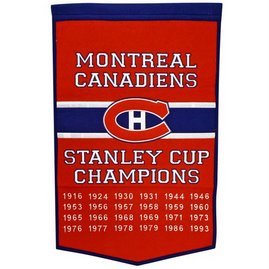
Following the Canadiens greatest decade, the 1970's, one in which they captured six Stanley Cups, the 1980's represented changing times for the Habs. Many player greats had retired, a legendary coach had moved on, and Sam Pollock was no longer in charge.
The new realities of the NHL landscape were also altered. There were more teams than ever before, more areas to choose players from, and hardly anyone willing to deal with the leagues reigning dynasty.
It wasn't all doom and gloom for the Canadiens. They ably maintained their regular season mastery - it was just that their post season prominance had lost it's edge. The aging team of recent glory, despite the youthful insurgance being brought on, became a paradox to evaluate. Where the team was headed hit a wall by the middle of the decade, through great pains. Fortunately, it was quickly revived in time for a Stanley Cup win in 1986, and a close run to the finals of 1989.
In Toronto, things never seemed worse. So far gone were they from their winning years, fans began bagging their heads at home games to hide their shame. The Maple Leafs and their fans endured a decade of embarrassment and humiliation as the team became league doormats. Sadly, Toronto were bankrupt for direction and solutions to their ills, and mistakes were made repeatedly.
As the 1980's ended, Montreal lost the 1989 Cup final to the Calgary Flames, captained by former Leaf Lanny McDonald. The Leafs woes were a few years away from finding the light of day, as the decade closed.
From 1980 to 1989, more players than ever wore the Habs and Leafs jerseys. Included among them, were not the usual quantity of players having won it all before, but rather players who represented one time hopes for both teams.
Trades were once again consumated between the teams, and prospects were the order of the day. Players not panning out on one side, represented curiosities for the other upon aquisition.
Fourteen players shared the jerseys of Canada's two most popular teams, and here is what played out:
The 1980's
Michel Larocque ( = )- MON 1973 - 81*****/TOR 1981 - 83
MON: 231-144-48-31 / 12-6-5
TOR: 74-16-35-13 /

Michel "Bunny" Larocque was the backup to the Canadiens Ken Dryden for seven seasons and when Dryden retired, it was perceived that Larocque would grab the Habs goaltending mantle. Montreal threw a wrench into those perceptions when they aquired Denis Herron to share the puckstopping duties.When injuries slowed Larocque down and his play left much to be desired, the play of younger goalies such as Richard Sevigny and Rick Wamsley stepped up making Larocque valuable and expendable.

The Maple Leafs came calling, offering highly touted, but faltering defenseman Robert Picard for Larocque, and the Canadiens snapped him up. Picard was often inconsistant in Montreal, and was traded to the Winnipeg Jets three seasons later.
Larocque never helped the Leafs fortunes through two seasons of erratic play, and he finished out an injury plagued few years with Philadelphia and St. Louis.
Robert Picard ( = ) - TOR 1980 - 81/MON 1981 - 84
TOR: 69-6-19-25
MON: 141-11-61-72 / 9-1-12
Picard was a defenseman the Habs had had their eyes on since he was drafted 3rd overall by the Capitals in 1977. He had all the tools - size, vision, and smarts. Possibly because of playing for weak defensive teams such as Washington and Toronto, his savior status was never in evidence. Montreal still felt he had game, and we're confident of a steal upon his aquisition from Toronto.
It could be suggested that pressure was Picard's undoing. One night he would look like Larry Robinson, and the next night an awkward rookie. In the summer of 1984, the Habs gave up and cashed him in for Winnipeg's third pick in that June's NHL Entry Draft - Patrick Roy.
Gaston Gingras ( = ) - MON 1979 - 83/TOR 1982 - 85/MON 1985 - 88*
MON:247-34-102-136 / 32-4-12-16
TOR: 109-17-40-57 / 3-1-2-3
As a defenseman, Gingras was like Al McInnis withous a conscience. A power play specialist with a booming point shot, he never was able to bring a rounded game to the Habs table. As his play deteriorated over three seasons, the Canadiens dealt him to Toronto for a second rounder in the 1986 draft - Benoit Brunet.

After two and a half seasons of the same double edged miseries with the Leafs, Toronto sent Gingras to the minors. Montreal reaquired him for minor leaguer Larry Landon, and after being regroomed with the Habs farm team in Sherbrooke for two seasons, he made it back to the Canadiens as a more solid defender, and was an integral piece of the 1986 Cup winning Habs.
(Trivial Robert L Note: I was at Gingras first game back with the Habs - Saturday, January 18, 1986 - a 3-0 win for the Habs. The Alexis Nihon Plaza, across from the Forum, had a fire the night before.)
Dan Daoust ( = ) - MON 1982-83 /Tor 1982 - 90
MON: 4-0-1-1 /
TOR: 518-87-166-253 / 32-7-5-12

Daoust was signed as a free agent out of junior after captaining the Cornwall Royals to back to back Memorial Cups in 1980 and 1981. As a Nova Scotia Voyageur for one season, he was being groomed as a defensive specialist in the Doug Jarvis mold. The problem with Daoust was - so was Guy Carbonneau, who beat him out for a job at the start of the 1982 season.
Traded to Toronto for a draft pick, Daoust become a consistant contributor to some dismal Leafs squads during the 1980's. Pretty fair showing for an undrafted late bloomer.
Jeff Brubaker - MON 1981 - 82/TOR 1984 - 86
MON: 3-0-1-1 / 2-0-0-0
TOR: 89-8-4-12 /
Brubaker was a tough competitor employed mainly for fists over hands. He played for five different franchises, often being a pre-season waiver claim for teams needing toughness. Montreal liked something in Brubaker's game when he appeared with Hartfort, and claimed him prior to the 1981 season. He suited up periodically for the Habs and toiled with the Nova Scotia Voyageurs for two years until Chris Nilan made his role redundant. After joining the Calgary Flames, Brubaker was waived again and soon joined the Leafs. With Toronto, a more experienced Brubaker extended his usual stay with the odd goal and some feisty play.
Serge Boisvert - TOR 1982 - 83/MON 1984 - 88*
TOR: 17-0-2-2 /
MON: 29-5-5-10 / 23-3-7-10

Boisvert played 17 games with Toronto in 1982 as a rookie, but spent most of his time in the minors. He was traded to the Edmonton Oilers, but never played an NHL game for them. After signing as a free agent with the Canadiens, Boisvert was a mostly farmhand who was called up for a few games as an injury replacement in each of his four years with the club. In 1986, he won a Stanley Cup with the Habs, where his element of speed made him a dangerous offensive threat in close games.
Early in the 1987-88 season, Boisvert committed himself to the Canadian National Team. He scored 22 goals in 63 exhibition games then scored seven goals in eight matches for the team at the 1988 Calgary Olympics.
Bill Kitchen - MON 1981 - 84/TOR 1984 - 85
MON:12-0-0-0 / 3-0-0-1
TOR: 29-1-4-5 /
Bill Kitchen was a reliable stay-at-home defenceman who spent some time with the Montreal Canadiens and the Toronto Maple Leafs in the early 1980s. Along the way he was an efficient blueliner in junior and the minor leagues. Kitchen's older brother, Mike, also played in the NHL for several years.
Most of Kitchen's first three pro seasons were spent in the AHL with the Nova Scotia Voyageurs. The Habs did call him up on occasion but he eventually sought more ice time by signing with the Toronto Maple Leafs in August 1984. He split the 1984-85 season between the woeful Leafs and the St. Catharines Saints. He was a team leader on the St. Catharines club in 1985-86 before he announced his retirement.
Larry Landon ( = ) - MON 1983 - 84/TOR 1984 - 85
MON: 2-0-0-0 /
TOR: 7-0-0-0
Right winger Larry Landon played briefly with the Montreal Canadiens and Toronto Maple Leafs in the mid 1980's. He was a decent checker and playmaker who enjoyed most of his success in college and the minors.
In February 1985, Landon was traded to the Maple Leafs for enigmatic defenceman Gaston Gingras. He played seven games for Toronto, but spent most of his time with the St. Catharines Saints of the AHL where he scored 21 goals in 44 games before retiring.
Bill Root - MON 1982 - 84/TOR 1984 - 87
MON: 118-6-16-22 /
TOR: 96-4-5-9 / 20-1-2-3

Throughout Bill Root's career in hockey, he always seemed to play under a cloud of doubt tinged with some vague, amorphous sense that he might not make it wherever he was.
Root was never selected in the NHL draft. The Montreal Canadiens, signed him as a free agent in 1979. Root was immediately assigned to the Canadiens AHL affiliate, the Nova Scotia Voyageurs. There he toiled for three seasons with hardly a hope of cracking the Canadiens powerful defensive corps led by Larry Robinson and Rod Langway.
Root had a number attributes that often seemed overlooked during his ins and outs with the NHL. Such attributes, however, weren't enough to earn Root a permanent home with the Habs. He did manage to eke out one full season in 1983-84, but then the arrival of Chris Chelios, Tom Kurvers, and Petr Svoboda made him expendable. As a result, he was dispatched to the Toronto Maple Leafs for the start of the 1984-85 campaign.
With Toronto, Root had some initial success while paired with Chris Kotsopoulos, but untimely injuries and occasional trials with the team's management seemed to always undermine any momentum Root could manage to sustain. As a rearguard who always played a sound, physical game, he was baffled to have been sent to the minors by Leafs' coach John Brophy because he wasn't sufficiently aggressive.
Russ Courtnall ( = ) - TOR 1983 - 88/MON 1988 - 92
TOR: 309-90-128-218 / 29-8-11-19
MON: 250-82-113-195 / 55-22-10-32

Coming out of junior hockey, Russ Courtnall was considered one of the top prospects in 1983 and the Toronto Maple Leafs selected him seventh overall in the Entry Draft. As a rookie with Toronto, he scored 12 goals and 22 points in 69 games. Although his goal production was not as high as the Leafs had hoped for, his tremendous speed opened up opportunities, especially for his linemates.
In 1985-86, Courtnall notched 22 goals and 38 assists for 60 points. His offensive numbers improved the following year with 29-44-73 totals, but always seemed unable to please coach John Brophy, who preferred big, rough and tumble type of players to that of Courtnall's speed and finesse.
When Courtnall's offensive production decreased in 1987-88, the Leafs braintrust decided his days in Toronto were numbered. After nine games in 1989, the Leafs dealt Courtnall to the Montreal Canadiens for John Kordic, who by all accounts was nothing more than a team goon. Although Courtnall's stock had dropped, most observers felt Montreal got a steal in that trade.

As Courtnall joined the Canadiens, he was determined to prove to himself. In 64 games, Courtnall put up 39 points with the Habs, and his lightning fast skating and breathtaking moves made him a fan favourite. Some said his style reminded them of Yvan Cournoyer. Being more at ease with his new club, Courtnall saved his best performance for the playoffs, where the Canadiens advanced all the way to the Stanley Cup finals before losing to the Calgary Flames. In 21 post-season games, Courtnall contributed eight goals and 13 points.
Courtnall enjoyed another two and a half years in Montreal before joining the Minnesota North Stars for the 1992-93 season.
John Kordic ( = ) - MON 1986 - 89*/TOR 1988 - 91
MON: 115-7-10-17 / 36-4-2-6
TOR: 104-10-6-16 / 5-0-1-1

A tough right winger who had scored more goals in junior than most people realized, John Kordic was relegated to the role of an enforcer in the NHL. He spent parts of seven years in the NHL with four different teams before his untimely death at the age of 27.
In 1983 Kordic was a member of the Portland Winter Hawks Memorial Cup team. A few weeks later he was chosen 80th overall by the Montreal Canadiens at the NHL Entry Draft. The rugged forward was placed on the WHL West second all star team in 1985 after scoring 81 points and playing a physically imposing game.
Kordic spent most of 1985-86 season with AHL's Sherbrooke Canadiens then played 18 playoff games as the Habs won the Stanley Cup. He joined Montreal for 44 games in 1986-87 and was chiefly an enforcer for the team until early in 1988-89 when he was traded to Toronto for Russ Courtnall. He struggled initially because Courtnall was a popular player and the Leafs were in turmoil. The next year he was given more ice time under coach Doug Carpenter and scored nine goals in 55 games.
After Toronto endured a miserable start in the 1990-91 season, Kordic and Paul Fenton were traded to the Washington Capitals for a draft pick. Kordic played only seven games for the Caps before signing as a free agent with the Quebec Nordiques in October 1991. He played 18 games for the Nords before loosing his life in the summer of 1992.
Craig Laughlin - MON 1981 - 82/TOR 1988 - 89
MON: 36-12-11-23 / 3-0-1-1
TOR: 66-10-13-23 /
Craig Laughlin was a talented right-winger who played over 500 NHL games in the 1980s. He was a fine skater with a quick shot who topped the 20-goal mark three times in his career and was asset on the power play.
The Toronto native was chosen 162nd overall by the Montreal Canadiens in 1977 after a solid freshman year at Clarkson College. He returned to play his last three years with the school then scored 32 goals for the AHL's Nova Scotia Voyageurs in 1980-81. He split the next season between the Vees and the Habs but was traded to Washington along with Rod Langway, Brian Engblom, and Doug Jarvis.
In February 1988, he was sent to the L.A. Kings for defenceman Grant Ledyard. Prior to the 1988-89 season, he signed as a free agent with the Toronto Maple Leafs. The club's struggles and apathy caused the veteran winger to voice his frustration in public.
Tom Kurvers - MON 1984 - 87/TOR 1989 - 91
MON: 138-17-58-75 / 12-0-6-6
TOR: 89-15-40-55 / 5-0-3-3

Tom Kurvers was a pure offensive defenceman with outstanding passing skills and a quick release from the point. In his eleven years in the NHL he was a considered a positive influence on the ice and in the dressing room.
Born in Minneapolis, Minnesota, he scored 175 points in four seasons at the University of Minnesota-Duluth between 1980 and 1984. His talent was noticed by the Montreal Canadiens who drafted him 145th overall in the 1981 NHL Entry Draft.
Kurvers enjoyed a fine rookie season with the Habs in 1984-85 when he played a regular shift and scored 45 points. By the start of his third year in Montreal, Kurvers was caught in a numbers game a traded to the Buffalo Sabres for a 2nd- round draft pick. He scored 23 points for the Sabres down the stretch in 1986-87.

An off season deal in 1987 brought Kurvers to New Jersey, where his offense sparked the Devils to an improbable playoff run that finished one win short of the Stanley Cup final. That year Kurvers was the second highest scoring blueliner in the post season with 15 points in nineteen games. The next year he recorded a personal high 66 points but, by 1989-90, was considered expendable when the Devils opted to use Bruce Driver to quarterback the power play.
Early in the 1989-90 season, Kurvers was shipped to Toronto for a first round pick that became Scott Niedermayer. 89 games later he was a Vancouver Canuck in return for Brian Bradley.
Gilles Thibaudeau - MON 1986 - 89/TOR 1989 - 91
MON: 58-12-15-27 / 8-3-3-6
TOR: 41-9-18-27 /
Beginning in 1986-87, he was a part time player in Montreal and a reliable point producer on the AHL's Sherbrooke Canadiens. During the 1988 playoffs he scored six points but gained more noteriety when he began shooting pucks in the direction of a few teammates at practice when venting frustration at not being dressed for an upcoming game.
The tricky forward was signed as a free agent by the New York Islanders prior to the 1989-90 season. He played two months for the club before he was traded to the offensive-minded Toronto Maple Leafs. Thibaudeau registered 18 points in 21 games and fit in well with the club that only played at one end of the ice. He played 20 games the next season for Toronto but spent most of his time with the Newmarket Saints of the AHL.
The Sum Of The Parts:
Of the 14 players who wore both jerseys, 11 went from Montreal to Toronto, with only Courtnall, Boisvert, and Picard heading the other way during this time. Montreal's track record speaks well here as Boisvert was an able substition when needed during the 1986 Cup run, Courtnall a top contributor to the 1989 goal that fell just short, and Picard's trading translating into the ultimate of draft pick lottery wins in the name of Patrick Roy, who made both the 1986 and 1993 Cups possible.
Toronto's use of the 11 former Habs fall into several categories.
In deals where they dealt directly with Montreal, snapping up Daoust was an astute move that cost the Leafs little, Larocque for Picard was a total bust in two consequencial extremes - Larocque was toast and Picard's upside unexplored, aquiring Kordic for Courtnall was an unqualified disaster, Gingras' temporary Toronto successes didn't add up to much - he was aquired for a pick that became Benoit Brunet ( a ten year Hab ) and returned to Montreal for a player who gave them all of 7 games in Landon.
Root was a free agent pickup that served them well for a time. Thibaudeau's game - as Toronto would find out what Montreal had already learned - had it's limitations. Kitchen, Brubaker, and Laughlin were uncostly spare parts that affected little in the grand scheme of things. Kurvers enabled the Leafs to turn a slow start into an early playoff exit at a hefty price named Scott Niedermayer.
The Final Tally:
The players and transactions detailed above are an apt representation of where each team was at in the 1980's. Toronto recycled used goods into preconceived expectations, while Montreal parlayed it's aquisitions into further gains. It likely has much to do with evaluating a talent's upside and how each team's goals affected long and short term needs.
When Russ Courtnall hit a dead end in Montreal, he was exchanged for Brian Bellows, who scored 40 goals for the 1993 Cup winning Habs. Not long after that, John Kordic's NHL life and earthly existance expired simultaneously.
As the 1990's dawned, Montreal could speak of a future of promise. In Toronto, there was nowhere to go but up.