Showing posts with label Stanley Cup. Show all posts

Tuesday, December 26, 2006

Stanley Cup Facts and Folklore


The Stanley Cup, donated by Lord Stanley of Preston in 1892, is the oldest trophy competed for in North America. It was originally known as Dominion Hockey Challange Cup and the first winners were the Montreal Amateur Athletic Association.

Unlike other team sports trophies, no new Stanley Cup is made for each new years winner. It is the only trophy that engraves the names of the winning teams players, coaches, management and staff on it.

Beginning in 1915, the Cup was contested by the winners of two Canadians professional leagues, the HNA and the PCHA. When the NHA merged into the NHL in 1917, it continued to challenge West Coast league teams for the Cup until 1926, when it became property of the NHL. The league's official ownership of the trophy began in 1947.


There are actually three Stanley Cup in existance. The first is the original bowl that is enshrined at the Hockey Hall Of Fame in Toronto. A duplicate, made by Montreal silversmith Carl Peterson, is the one most seen, as it is awarded to the champions and used in promotions. When the duplicate is not on display at the Hall, it is replaced by a third replica in the Hall while the other one travels.

Currently, in order for a player to have his name engraved on the Cup, he must have appreared in a minimum of 41 regular season games or at least one game in the Stanley Cup final. The NHL does bend this rule at times, on a case by case basis.

Steve Brule, of the 2000 New Jersey Devils championship team, appeared in only one game in the Stanley Cup final, and has his name engraved on the Cup. Brule had never appeared in a regular season game up to this point. He played in a pair, three seasons later with Colorado in 2002, and never returned to the NHL.


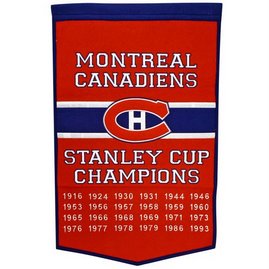
Players whose names appear the most on the Cup are Henri Richard (11), Jean Beliveau (10), and Yvan Cournoyer (10), all of the Montreal Canadiens. The Canadiens have won the most Cups, 23 in the NHL, and one more before it's formation. Seventeen other Montreal area teams are immortalized on the mug, Including the Wanderers (4), the Maroons ( 2) the Victorias (5), the Shamrocks (2), and the AAA (4).

The smallest town to ever conquer the Cup was the 1907 Kenora Thistles, population 4,000. The Thistles, led by Art Ross, defeated the Montreal Wanderers in a two game, total goals, series.
Kenora Thistles - 1907
The 1896 Winnipeg Victorias started one of the oldest Cup winning traditions by drinking champagne from the bowl.

Prior to 1930, the Cup was never awarded after the game it which it was won. Beginning with the 1932 Toronto Maple Leafs, the Cup was presented on ice to the teams captain. In 1950, Ted Lindsay of Detroit, became the first captain to hoist the Cup over his head and begin a victory lap around the rink. Throught time, each player on the team would have their own lap of glory.

Two captains that broke with the hoisting tradition, did it with class. In 1998, Detroit captain Steve Yzerman handed the Cup directly to Vladimir Konstantinov, wheelchair bound, and proceeded to follow him around the ice during the first lap. Two seasons later, Colorado Avalanche captain Joe Sakic passed the Cup to 22 year veteran Raymond Bourque to hoist it first.

Many superstitions about the Cup revolve around touching the sacred mug before it has rightfully been won. While there are many tales of players who have touched it and lost, Stephane Matteau of the 1994 New York Rangers, claims that he tapped it gently with his stick before game 7 of that years Eastern Conference final. Matteau, an unlikely hero, scored that games overtime goal that pushed the Rangers to the final and eventually to Stanley Cup glory.

Another superstition involves the touching or raising of the Prince of Wales and the Clarence S. Campbell Bowl. Many have told of the jinx incuured of celebrating anything secondary to the Stanley Cup. Mario Lemieux, of the 1991 and 1992 Pittsburgh Penguins, is the last known celebrant of the Wales trophy to go on and win the Cup. Ever since, each team captain who has dared to touch a conference title trophy, has gone on to lose.

Starting in 1995, each winning player on a team was allotted one private day with the Cup, accompanied by a representative of the Hockey Hall of Fame. Prior to that date, and since, what went on with Cup holders is the story of many legends.

Starting in 1995, each winning player on a team was allotted one private day with the Cup, accompanied by a representative of the Hockey Hall of Fame. Prior to that date, and since, what went on with Cup holders is the story of many legends.

In the late 1970's, while the Montreal Canadiens were in the midst of four straight Cups, Hall of Famer Guy Lafleur literally stole it for himself for a day. Somehow, Lafleur managed to get the car keys to PR director Claude Mouton's vehicle. After the Cup had been placed in Mouton's car trunk, the sneaky Lafleur removed it and placed it in his. When Mouton discovered it missing, ha had no clue as to how it was lost. He alerted the Canadiens, who then called the authorities. The following day, news spread fast that Lafleur had been publically displaying the Cup on his parents front lawn in Thurso, Quebec. Seems the entire populace of the small town had their moment with it.

In 1999, Brett Hull, while shopping with Mike Modano, locked it inside his car - along with his car keys!

In the long history of the Stanley Cup, there have been many adventures and misadventures. The Cup has been around the world more than once, dropped from heights, thrown in water, and forgotten by the roadside after Cup holders fixed a flat.

Many of the names inscribed on it have been mispelled. The names of a number of women are also on the Cup. Once, a name that had no business being there in the first place, was x'd out.

In 1984, Oilers owner Peter Pocklington, included his father Basil's name, although he had absolutely no connection to the winning team.

The most awesome resource for information in every regard of the Stanley Cups history can be found through this Wikipedia link. It is a litany of every minute detail and a great link to add to your favorites for any hockey fan. You'll want to go back time and again.

Its many sections detail facts I've only scraped the surface on. They include the origins of the Cup through it's challenge years before the NHL took it over. It covers the multitude of adventures and mishaps over it's history. It details names engraved, provides many unique anecdotes, and has lots of information on Stanley Cup finals of note.

It has stories from almost every Cup win in over a hundred years and it's external links are very broadbased.

I highly recommend taking a cruise through it all. You will inevitably learn a bunch of interesting facts you never knew about the Cup.


Saturday, November 18, 2006

# 18 Raised To The Rafters!


Serge Savard was known as 'The Senator' for as long as most fans can remember. Inspiring what famed broadcaster Danny Gallivan loved to call the 'Savardian Spinarama,' he was an integral part of one of the greatest eras in Montreal Canadiens' history. He was an integral cog, part of a dynamic defensive troika that included Larry Robinson and Guy Lapointe, that helped lead Montreal to eight championships in twelve years. Tonight, the Canadiens will raise his jersey #18 to the rafters.

Savard was as dependable as a defenseman gets. Flashy at times for his era, he was a player coach Scotty Bbowman could throw on the ice in every crucial situation.

Serge Savard's blood pumped red, white, and blue, the colors of his beloved team in his youth.

Born on January 22, 1946 in the village of Landrienne, Quebec, Savard followed the results of the Canadiens from childhood, and when the eleven-year-old, already standing close to six feet tall, moved to Montreal his passion grew even stronger. By fifteen, Serge had been placed on the Habs reserve list. He progressed quickly through the minors, joining the Montreal Junior Canadiens in 1963-64 where he was made captain.

He graduated to the big club in 1967-68 and the Canadiens won the Stanley Cup for the 3rd time in three seasons.

In his second NHL season, Savard was becoming the dominant team player we reflect back upon today. For a second straight season, Montreal not only finished first in the East, but proceeded to capture the Stanley Cup. Savard was outstanding, blocking shots, clearing the zone and collecting ten points in fourteen games. His four goals was one shy of an NHL record for playoff goals by a defenseman in one season and helped earn Serge the Conn Smythe Trophy as the most valuable playoff performer as his Canadiens swept the St. Louis Blues in four games.

But injuries hampered Savard's continued progress. In a March 1970 game against the Rangers, Serge crashed into a goal post and broke his leg in five places.

"There was a time when I was afraid I wouldn't play again. My leg was broken in three big places besides the chips and I got scared after the doctor took off the cast for the first time. The break was moving inside," Serge recalls.

To complicate matters, Savard returned to the Canadiens only to break the same leg again in February 1971. Caught by a Bob Baun hipcheck in a game against Toronto, the break put Serge out of action for close to a year. But the break did more than put Savard out of action; it changed his style of play.

"When I was younger, I was more of a rusher but after the two bad leg injuries, I didn't have the same speed so I became more of a defensive defenseman," states Serge.
Although never afraid to carry the puck, Savard was found to be invaluable in his own end.

"Not many guys are hurt stopping shots," Serge explains, describing his skill as a shot blocker. "You could get killed if you get hit in the temple but the average is good. I turn sideways from twenty to twenty-five feet away and let the goalie take it. He can see it better. To me, there's no danger if you time it right. You have to be almost on top of the shooter before falling."

Despite missing substantial portions of two seasons, Serge Savard was chosen to be a member of Team Canada in the 1972 Summit Series against the Soviets.

Serge Savard played fourteen seasons as a Montreal Canadien, and was part of eight Stanley Cup championships during that time, including four consecutive between 1976 and 1979. Serge was Montreal's captain from 1979 to 1981.

On August 12, 1981, Savard decided that he had had enough. The team had been struggling and Savard, who had proven to be a savvy businessman through his years with Montreal, decided to pursue those interests outside of hockey. After turning professional with Montreal in his early 20s, Savard had begun purchasing apartment buildings at low cost and refurbishing them. His business acumen was enough to make Serge stand out in a sport where but a handful of players oversee their own affairs. While his teammates were playing cards or reading sports magazines, Serge was reading The Wall Street Journal.

That afternoon, Savard stated, "This is the most difficult decision of my life. As a player, you know this day is coming but you never want to believe it."

Toe Blake, the former coach of the Canadiens, added, "It's been said that anyone can be replaced, but that's not the case here."

Savard's old roommate, John Ferguson, plucked the star defenseman in the waiver draft that summer and attempted to convince Serge that he should reconsider his retirement and become a Jet in Winnipeg. Ferguson and Savard were partners in several thoroughbred racehorses, and the sales pitch was solid. "

I didn't really want to come back," Savard explains. "I was receiving calls from John. I saw that the Jets weren't the same as the year before or else I wouldn't have come back, but the club had Dale Hawerchuk, a rookie phenom, and was going for first place. I hadn't enjoyed the game the previous few years. Things were on a sour note with the Canadiens. There were a lot of young defensemen waiting in line. I made the right decision. I felt wanted by Winnipeg and the atmosphere was very different."

Savard spent two seasons with the Jets, guiding the team to the division semifinals both seasons.

Then, with much fanfare, the Montreal Canadiens hired Savard as Managing Director on April 28, 1983.

"It was a fantastic feeling to be back with the Montreal organization where I had so many friends and memories," remembers Savard.

Montreal sent a third-round draft choice and $50,000 to Winnipeg to get Savard released from the final year of his contract with the Jets. He retired as a player having played 1,040 regular season games in which he accumulated 106 goals and 333 assists for 439 points. Savard added 19 goals and 49 assists for 68 points In 130 playoff contests.

Besides the Conn Smythe Trophy in 1969, Serge won the Masterton Trophy for perseverance and dedication in 1979. That same year, he was selected for the NHL's Second All-Star Team. But individual awards eluded the wily veteran, even though his considerable presence contributed greatly to the eight Stanley Cup championships won during his prestigious career.

"I never pay attention to individual awards and I think that sometimes, too many people place too much value on them" , savard has said.

As the Canadiens GM, Savard was easily as clever as he had been both on the ice and in his personal business career, which had amassed him a considerable personal fortune. In 1986 and 1993, the Canadiens won the Stanley Cup, while the team went to the finals in 1989.

Five games into the 1995-96 season, the club replaced Jacques Demers as coach with Mario Tremblay and fired Serge Savard, replacing him with Rejean Houle.

Hurt, Savard commented, "My personal feeling was that it was unfair because I was convinced I could find a way to turn things around. I'd done it before, but I understand that the team wanted to make a change."

Savard turned his attention away from hockey and continued developing his business ventures. He built a new career as a real estate developer, hotel owner and investor, and garnered considerable power in both the business and political arenas.

"I guess I'm like everybody else," Savard admits. "You've got to have something in life that you're proud of. You have to achieve something."

Serge Savard has achieved a considerable amount and has considerable reason to justify his pride. His hockey legacy includes ten Stanley Cup rings (two in management and eight as a player) and representing Canada in the 1972 Summit Series and the 1976 Canada Cup. The piece de resistance for Serge Savard came with his 1986 Induction into the Hockey Hall of Fame.