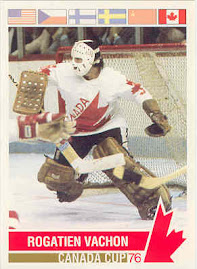
I'll be right up front - I think it is hockey blasphemy that Rogie Vachon, with 355 career wins to his credit, is not in the Hockey Hall Of Fame.
A quick surface checkmark of Rogie's achievements shows he has all the prerequisit crendentials: Stanley Cup championships, Vezina Trophy winner, All Star Games, All Star Teams, jersey number retirement, and MVP in the 1976 Canada Cup, on top of retiring in 1982 as the game's fifth winningest goalie.
So what is the argument for his exclusion? The most mundane response has been that while Vachon was a top goalie during his time, he was not consistantly dominant.
If that is why he is not in the Hall, it is an awful frail excuse after 355 wins.
How many players are consistantly "dominant"?
Since when has excelling over the course of a long career not been good enough?
The truth behind Vachon's exclusion may tie into the fact that only a certain amount of players gain entry each year, and if a player isn't a slam dunk to get it on the first few ballot years of eligibility, then their case continuously gets pushed aside in favor of the more popular and possibly more recent choices. As time goes by, and more players become eligible, greats the likes of Vachon, Dino Ciccarelli, and Glenn Anderson are neglected.
This past year the Hall inducted a bumber crop that included Mark Messier, Al McInnis, Ron Francis, and Scott Stevens - monoliths and icons each. There was hardly room for Rogie this time around.
Every few years, the Hall committee who votes these players in gains a rearview conscience and tables a former star for consideration. In 2005, Dick Duff slipped through this crack despite cackles of discontent from those who claim more worthy nominees were again passed over. For all I've learned about Duff, he was a gamer, but it really should have been Vachon's time to get the call.
The fact remains that Rogie Vachon is the greatest goalie not enshrined in the Hall. And it is sacrilege in my heart and eyes, and many other people, Dave Stubbs at the Gazette, T.C. Deneault at Habs World, Spector's Lyle Richardson, just to name a few, feel the same way.

In order to make a very precise case for Rogie's inclusion, I headed over to the Hall Of Fame website itself to compare him against those goalies already inducted. I wanted to see if there was a certain established criteria through the ages and era's that would clarify what contitutes a Hall Of Fame goalie.
What I found is rather interesting. Other than Stanley Cups championships, there seems to be no one facet of greatness that makes making the Hall for a goalie a certainty. Not even domination. It is rather a cumulative career view that enables a Hall perspective. Making It does not seem to hinge on the purely statistical either, and longevity is often forgiven in the cases of extreme greatness, as it ought to be.
In essense, for a goalie, it is everything added together that renders him a Hall Of Famer.
Rogie meets every requirement, in addition to having a synonymous goalie sounding name!
What I could not believe, is that there are only 32 goaltenders in the Hall. Even more surprising is the fact that only eight of them have played the prime years of their careers in the post 1967 expansion years.
These "modern day stoppers" if you will, are Gerry Cheevers, Ken Dryden, Tony Esposito, Grant Fuhr, Eddie Giacomin, Bernie Parent, Patrick Roy, and Billy Smith and they are the only goalies so honoured in the 40 years since the league doubled in size in 1967. All but Giacomin have won a Cup - so credit Stan Fischler for having a loud mouth.
The remaining 24 goaltenders in the Hall span the NHL's previous 50 seasons, the formative NHA years, and others leagues from the early 1900's.
Taken all together, there is almost a ratio of one honoured goalie for every two years of the NHL's pre 1967 expansion existance, but only a ratio of one for every five years since. ( Of course it is possible that ratio is altered soon with the future inclusion of worthy stoppers such as Martin Brodeur, Dominik Hasek and Ed Belfour.)

When one considers that only six teams comprised the NHL for all of those years, that the amount of teams has quintupled since, producing almost ten fold the number of goalies in the game, it isn't hard to agree that cases have been overlooked - starting with Vachon.
Before teams began carrying two goalies, the position was even more crucial to the fate of the team. With goalies then playing in practically every game, their worth was much simpler to discern. It can almost be assumed that every respectable goalie from the era Original Six era is enshrined - minus the equally forgotten Lorne Chabot and Dave Kerr.
All this has likely affected the perceptions of the more modern goalies and players by those in charge of tabling the Hall nominees careers for inclusion. The committee members are made up of former players and managers who may well think like my own father when he says that players are not made up of the same mettle these days.
There's a point to be made about that, but it actually is quite besides the point, and it shouldn't affect the scope of a player's modern day achievement in an era where it has gotten tougher and tougher to "dominate".
Heck, even the Dominator didn't totally dominate all the way to Stanley until landing with a team in front of him!
Curiously, eight of the 24 goaltenders enshrined in the Hall began their careers in the pre - NHL National Hockey Association or even earlier. They are: Clint Benedict, Bouse Hutton, Paddy Moran, Hugh Lehman, Harry Holmes, Riley Hern, Percy LeSueur, and George Vezina.
More knowledgable fans have surely heard of Benedict and Vezina, who's name graces the trophy that awards goaltender excellence. LeSueur and Hutton were great goalies for the powerhouse Ottawa Silver Seven and Senators teams at the beginning of the century - members of hockey first true dynasty. Hern was the rock behind the Wanderers championships and Lehman was the goalie for high priced Vancouver Millionaires championship in 1915. Holmes won his Cups outside the NHL/NHA sphere, and was a west coast hockey legend. Moran backstopped the Quebec Bulldogs to back to back titles in 1912/13.

For goalies in this bygone era to be compared to other eras is practically unfair to both, as seasons tended to be 12 to 30 games long, plus playoffs. What they have in common is that they were the best of their day - bar none. They all won Stanley Cups. Benedict and Vezina were career wins leaders when their time was up.
For the goalies of the Original Six era ( roughly 1930 to 1967) to be Hall worthy, a bar was seemingly set, and the 15 enshrined from this time needed to exceed it.
These 15 goalies are: Roy Worters, Alex Connell, Bill Durnan, George Hainsworth, Frank Brimsek, Johnny Bower, Tiny Thompson, Turk Broda, Harry Lumley, Gump Worsley, Glenn Hall, Terry Sawchuk, Jacques Plante, Chuck Rayner, and Chuck Gardiner.
Of these, arguments could be made that the careers of Worters, Brimsek, Rayner, and Gardiner didn't meet the set bar. Gardiner, and Brimsek won but one Cup, while Worters and Rayner did not. All four were simply very good goalies for their time and shared glorious highs while not members of great teams for long. They shared in the individual awards of the day, with one in six odds of being recognized for their efforts. Don't even bring up the word domination!
For the remaining eleven goalies of the era, their achievements are foregone conclusions. All greatly surpassed the Benedict/Vezina bar, and along the way Broda and Lumley set new heights for Plante, Hall, and Sawchuk to exceed. Goalies nearing or surpassing these achievements would surely be considered greats of their time, and most definitely headed for the Hall Of Fame.
To see exactly how Rogatien Vachon measures up today, having glanced back to the past, he must now be compared with the modern era goalies in the Hall - Cheevers, Dryden, Esposito, Fuhr, Giacomin, Parent, Roy, and Smith. Additionally there is one more goalie from this era - Vladislav Tretiak - who came to prominance in 1972 the Summit Series, and whose overseas career in Russian league play, the Olympics, and international tournaments makes his inclusion in the Hall an intelligent and distinct one.

Beyond the high points in Vachon's career, his win total stands as the truest testament to his worth and longevity - hence his greatness at the position. Here are the all of the Hall Of Fame goalies ranked by regular season wins. Stanley Cup championships are in paratheses.
I've added Rogie where he would fit in, in terms of wins - and he does not look out of place!
551 Patrick Roy - Canadiens/Avalanche 1984-2003 (4)
447 Terry Sawchuk - Red Wings/Bruins/Maple Leafs/Kings/NYR 1951-70(4)
437 Jacques Plante - Canadiens/NYR/Blues/Maple Leafs/Bruins 1952-74(6)
423 Tony Esposito - Canadiens/Blackhawks 1968-84 (1)
407 Glenn Hall - Red Wings/Blackhawks/Blues 1952-1971 (1)
403 Grant Fuhr - Oilers/Leafs/Sabres/Kings/Blues/Flames 1981-2000 (4)
355 ROGIE VACHON - Canadiens/Kings/Wings/Bruins 1967-1982 (2)
335 Gump Worsley - Rangers/Canadiens/North Stars 1952-74 (4)
330 Harry Lumley - Wings/Rangers/Hawks/Leafs/Bruins 1943-60 (1)
305 Billy Smith - Kings/Islanders 1971-89 (4)
302 Turk Broda - Maple Leafs 1936-52 (5)
289 Ed Giacomin - Rangers/Red Wings 1965-78 (0)
284 Tiny Thompson - Bruins/Red Wings 1928-40 (1)
271 Bernie Parent - Bruins/Maple Leafs/Flyers 1965-79 (2)
258 Ken Dryden - Canadiens 1971-79 (6)
250 Johnny Bower - Rangers/Maple Leafs 1953-70 (4)
252 Frank Brimsek - Bruins/Blackhawks 1938-50 (1)
246 George Hainsworth - Canadiens/Maple Leafs 1926-37 (2)
230 Gerry Cheevers - Bruins 1965-80 (2)
208 Bill Durnan - Canadiens 1943-50 (2)
193 Alex Connell - Senators/Americans/Maroons 1924-37 (2)
190 Clint Benedict - Senators/Maroons 1912-30 (4)
171 Roy Worters - Pirates/Americans/Canadiens 1925-37 (0)
138 Chuck Rayner - Americans/Rangers 1940-53 (0)
112 Chuck Gardiner - Blackhawks 1927-34 (1)
103 Georges Vezina - Canadiens 1910-1926 (2)
87 Percy LeSueur - Silver Seven/Senators 1905-16 (3)
47 Riley Hern - Wanderers 1907-11 (3)
39 Harry Holmes - Arenas/Metropolitans/Cougars 1917-26 (3)
20 Hugh Lehman - Millionaires/V.Maroons/Blackhawks 1914-28 (1)
?? Paddy Moran - Bulldogs 1911-13 (2)
?? Bouse Hutton - Ottawa Silver Seven 1903-04 (4)
?? Vladislav Tretiak - Russia 1969-85 (0)
Here is a listing of all goaltenders having won 200 games, prior to the 2007-08 season.
Now to place Vachon's career and achievements in the right perspective, one has ro remember than upon retirement Rogie was fifth in total career wins. That should never be overlooked even though his total has been surpassed.
It is also neccessary to break Vachon's contemporaries and peers down in detail, and view each goaltender separately. It is purposeful to examine what each meant to their respective teams, and in consequence, what each of those teams meant to the time they played in.

In doing this, I will eliminate four goaltenders in respect to comparisons with Vachon.
Patrick Roy and Grant Fuhr began their careers as Vachon's ended and perhaps are best grouped in a later generation of goaltenders.
Ken Dryden and Billy Smith were both members of powerhouse dynasties. Their teams won successive Cups due to lineups that had no single weak link. Comparing these goalies, and their teams, to what Vachon played behind in Los Angeles would be completely unfair.
Having said that, I will say that had Montreal or the Islanders had Vachon in goal, with the way he performed for the Kings, there is a good chance they would still have won those Cups. Rogie with the Big Three of Robinson, Savard, and Lapointe in front of him, and three lines of offense, would have had his name engraved on the Cup further, and would have fared as Dryden did. Vachon had the one punch threat of the Triple Crown line, Butch Goring's defensive savvy, and a bevy of nameless defenseman to shelter him. Like I say, it's an unfair comparison in more than one way.
Looking for the proper comparisons, we are left place Rogie Vachon alongside of Ed Giacomin, Gerry Cheevers, Tony Esposito, Bernie Parent, and Tretiak.
Giacomin never won the Stanley Cup, but made it to the 1972 final, losing to the Bruins. He began as a number one goalie in the same year as Vachon, and immediately started playing in close to 70 games per season with Rangers. Both Giacomin and the Rangers seemed to have more success when his workload was slightly reduced with the arrival of Gilles Villemure. During his career, Giacomin won as many as 30 games five times. He registered a career total of 54 shutouts in 609 games on a deep team that had Brad Park as it's best defenseman, and the likes of Jean Ratelle, Rod Gilbert, and Phil Esposito priming a halfway decent offence. The Rangers never scared too many teams late into the playoffs, but were consistently good during Giacomin's reign. He was definately a very good goaltender during his time. Whether he truly deserved Hall Of Fame recognition is somewhat debatable. As Giacomin closed in on nearly 300 career wins by the term of his time, he was most definately one of the most popular Rangers of all time and surely the greatest Ranger goalie ever.
Cheevers played 11 of his 15 career years with the Bruins. He spent four seasons in the WHA with the Cleveland Crusaders from 1972 to midway in the 1976 season wherin he bolted the team, was suspended, and later released to facilitate his return to the Bruins, where he played his final four seasons. He won 230 games with Boston and another 99 in Cleveland, where he appeared in over 52 games in three successive years. His claim to Hall fame lies in his 53 career playoff wins, most of them coming while a member of the early 1970's Bruins, a never before seen power bolstered by the likes of Bobby Orr and Phil Esposito, and a crew that tallied 399 goals one season. Cheevers never played more than 52 games in one year with Boston. Most often during those seasons, he split the goaltending chores down the middle with Eddie Johnston or Gilles Gilbert, playing 40 to 45 games each year, and only once did his win total hit the 30 plateau. When Cheevers left for the WHA, the Bruins were still strong enough to reach the Stanley Cup final, and maintain itself near the best in the league. For those who have suggested than goalie dominance is a key factor for Hall Of Fame recognition, they will find little evidence of that in Cheevers resume. He was, in my esteem, a slightly above average goaltender who played on some killer teams. He did rack up a great number of post season wins, but was often challenged to win the bigger games despite the team in front of him.

Bernie Parent's path was similar to Cheevers in that both skipped to the WHA at one time. When Parent returned however, he rejoined a Philadelphia team that was prepared to set the NHL on it's heel. Parent backstopped the Flyers to successive Stanley Cups and a third appearance in the finals, playing as many as 73 games one season. He set an NHL record of 47 wins in 1977. Parent was a workhorse for the Flyers whose brilliant career was just entering it's twilight when an eye injury forced him from the game. His place in the Hall is without debate.
Tony Esposito set the benchmark for workhorse goalies with 6 seasons of more than 60 games played. For seven consecutive years he won over 30 games. He took the Chicago Blackhawks to two Stanley Cup finals in which they were beaten by Montreal twice. Esposito's name is engraved on the Cup with the 1969 Canadiens, from having played 13 regular seasons games with the Habs. He has had 5 All Star Team placings, won both the Calder and Vezina Trophies, and played a part in the 1972 Summit series, earning two wins and a tie. His legacy is as firm as his win total - he finished win 423, becoming only the fourth goalie to hit the 400 win mark. His place in the Hall is also without debate.
Vladislav Tretiak's career is slightly different to assess as he didn't compete against NHL talent often. Despite that blip, Tretiak dominated against the competition he did face for the better part of 14 years. While he was not an NHL goalie, he definitely would have been one of it's best during his long prime. His mass of personal achievements and his dedication to teaching a game he purely loved gives him the aura, in my esteem, of a Russian Jacques Plante. While Tretiak's play against North American hockey had its disappointing moments, his play was excellent. He deserves his place in a hockey hall - why not ours!
Now to bring back Vachon in the mix, comparing him against these five Hall Of Famers is hardly daunting. Vachon appeared in over 50 games per season ten times. He has won all the accolades mentioned at the top of this post. Like Esposito and Giacomin, he never won the Cup with a team while in his prime, but I doubt that either of these five others, or even Dryden for that matter, would have taken the Kings all the way. They were simply not a team equiped to go head to head with the 1970's best teams in Boston, Buffalo, Philadelphia, Long Island or Montreal.
Should the perception of Vachon's prominance and performance be affected by the strength of the team he starred for?

When looking deeper into the regular season statistics of each goalie's career, Vachon measures up quite well. Back in October of 2007, Habs World writer T.C. Deneault examined the Vachon slight in great detail. In a post entitled "The Man Who Would Be King", Deneault delves deep into the statistical comparisons of the goalies of this era. Here is what he found:
Esposito – 886-423-306-151-2.92-76 SO
Vachon – 795-355-291-127-2.99-51 SO
Giacomin – 609-289-209-96-2.87-54 SO
Cheevers – 418-230-102-74-2.83-26 SO
In the playoffs, only Vachon and Cheevers, on a strong Bruins team, have winning records.
Esposito – 99-45-53-3.07-6 SO
Cheevers – 88-53-34-2.69-8 SO
Giacomin – 66-29-35-2.81-1 SO
Vachon – 48-23-23-2.77-2 SO
There is little doubt that Vachon played on a Kings team that was inferior to Cheever's Bruins, Giacomin's Rangers, and Esposito's Blackhawks. Had the Kings been a sounder and deeper team, Vachon's record would have been better because of it. Often it was left up to Vachon to win games singlehandedly, as the Kings in those years rarely provided him with much offensive punch.

Deneault adds:
During his playoff career with the Kings, the team averaged less than two and half goals per playoff game in which Vachon played in. Not much margin for error. Here is a comparison of what each goalie's GAA was compared to their team's goals per game average.
Vachon/Kings 2.77/2.43
Giacomin/Rangers 2.81/2.76
Esposito/Blackhawks 3.07/3.02
Cheevers/Bruins 2.69/3.77
It's not without coincidence that when Vachon played for the Canadiens the team averaged 3.27 goals per game for him. His two Stanley Cup rings attest to what he was capable of with a strong team in front of him.

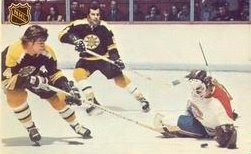
(Notice the caption above, "Goalie Vachon Heads a Cast of Castoffs")
If there are any doubts as to whether he was better than Cheevers or Giacomin or even the equal of Esposito, there shouldn't be. Giacomin couldn't hold up as well as Vachon over a long season, and Rogie beat out Cheevers as Team Canada's starting goalie in 1976.
Vachon was so stellar in that tournament in fact, that he was the only goaltender Canada needed to turn to as it won the tournament. Vachon went 6-1, and let in all of 10 goals in those seven games for a 1.39 GAA - proof for all to see of what he could have accomplished on a solid team. In the tournament, Rogie outplayed Tretiak - no mean feat! He was named Team Canada's MVP for the tournament.

Deneault then adds a whole new angle to the perceptions as to why Rogie remains an afterthought for the Hall of Fame:
Another reason why Vachon might have been passed over for the Hall could have to do with exposure. Hockey Night In Canada analyst Harry Neale once stated in this regard that "Vachon was probably a better goalie than most people thought, but you didn’t even get the Kings scores until two days later, and there were certainly no highlights of him playing."
Vachon played in an era before the 24 hour sports networks. Back in the 1970’s sports highlights were at best a ten minute package at the end of the nightly news. Since the majority of the Kings games didn’t end until one in the morning Eastern time, nobody ever got to see Vachon showcased on a consistent basis. Today, because of exposure, everyone knows how great Roberto Luongo is despite his career play in Florida and Vancouver.
Back then, not all the games where shown on television like they are now. People were able to watch whomever the Leafs or Canadiens were playing on Saturday night, and quite often it wasn’t the Kings. Had the Kings been apt to go deeper into the playoffs, more people would have seen Vachon play.
There was no internet then, so a fan's only way of knowing about Rogie or the Kings was by reading a newspaper on Wednesday that had a box score from a game the Kings played on Monday night. This lack of exposure has hurt Vachon and people’s memories of his career have suffered as well. We never saw him at his best and most of those memories are only possessed by those who were lucky enough to be in attendance that night. That doesn’t mean that Rogie Vachon, wasn’t one of the great goalies of his day, it means that he is however, the most forgotten and likely one of the least respected in consequence.

Another reason for Vachon not getting the Hockey Hall limelight could have alot to do with how members of the selection committee are not allowed to publicly discuss the logic behind their decisions or the process leading up to it. The Hockey Hall has a bylaw not to release the names of nominated candidates or voting results. Just the winners.
This not only cheats the fans of the excitement of the process, it dilutes the purposes of promoting the game.
It also cuts out the groundswell of public opinion behind getting players inducted. No one will read about Vachon being shunned for over 20 years because the Hall doesn't let it become news.
Brian Costello has just written an intriguing piece about why this is, and makes a great argument for why it shouldn't be.

Last year when Vachon turned 62 on September 8, Montreal Gazette and Habs Inside Out columnist Dave Stubbs put together an excellent piece on Rogie's career. The article/birthday present made a great case for Vachon's inclusion in the real Hockey Hall Of Fame.
Rogie is a sentimental favorite of both Mr Stubbs and yours truly, and I believe that hockey fans can make a difference in getting Rogie elected to the Hall. Heck, if we can come within a few week's votes of getting Rory Fitzpatrick into an All Star game, then anything is possible - especially the sensible.
Instead of putting a player unworthy of such an accolade in a position of embarrassment, fans of hockey could unite and feel wonderful about helping to bring an honour to someone who earned it and then some.
I am calling on the more popular hockey blogs and their creative genius to give this rally a boost. Perhaps if sites such as Habs Inside Out, Kukla, Mirtle, Spector, Off Wing, Greatest Hockey Legends and other popular sites could entice readers to write to the Hall Of Fame and get Rogie included on the ballot, the idea might hit it's stride.

Any fan can help bring a player up for nomination by writing to Jim Gregory, who is the Selection Committee Chairperson for the Hall at: BCE Place, 30 Younge St., Toronto Ont, M5E 1X8. Support your letter with a strong case for his consideration.
As Dave says, "All letters are circulated to the 18 member selection committee.Should a name be backed by even one member of the committee, a file is prepared, distributed, then discussed and voted upon at an annual meeting. With 75 per cent support of the 18 voters, a candidate is elected."
If you want a shortcut around writing your own letter of recommendation, simply print this post ans mail to the address above.
Earlier this week I posted about the Rogie Vachon Exposition is Palmarolle, Quebec, in the arena named after him in his hometown. It is a great story about how a pair of local fans sought to honour their all time favorite goalie. Last weekend I added the Rogie bio in the Habs Goalies series, and you can check it out here.