Happy New Years!
Often at this site, I've looked back on the careers of many of the Canadiens greatest players to examine what it is they brought to their respectives teams and era's during the winning years.
In Habs history, there will always be the associated linkage of greats the likes of the Rocket, Beliveau, and Lafleur, or goaltenders such as Vezina, Plante, and Roy, to explain what the blood and sweat of a winner's psyche, heart and guts enabled the team to accomplish.
But teams are made of more than just superstars and leaders. Often, it is the quality of the foot soldiers that lead teams to victory in battle. Consequently, the spotlight tends to pass them by, and their accomplishments are relagated away from headline status.
There are likely dozens of examples of players in Canadiens history that fit this bill.
Beyond the great players whose jerseys should be hung from up high (Newsy Lalonde, Aurel Joliat, Toe Blake, Bill Durnan), there are several whose exempliary careers did not even warrant them Hall Of Fame attention.
Undeservedly, they are tagged unsung heroes.
There are an abundance of unsung heroes in Canadiens lore, and what you are about to read is no ranked listing of the more glaring forgotten contributors, but simply some of my favorite ones whose special skills and gifts helped the Canadiens cause during their time. They could fall into several categories that run the gamut from stay at home defenseman to shut down specialists.
All told, I basically chose them, as players that I felt represented different ideals based on who they were and what they had to give. I'm certain any reader could create their own equally interesting list of unsung Habs heroes.
Claude Provost

Claude Provost was a career Montreal Canadien, playing for 15 seasons in the shadow of the games greatest players. From the mid 1950's, until the dawn of the 1970's, Provost was a steady and aggravating presence in the Habs lineup.
By the time he hung up the blades, he'd racked up 9 Stanley Cup rings, the most of any player not in the Hall Of Fame.
I've never seen Provost play during his time, but I've seen about a dozen replayed games from his time that testify to his worth. My father always mentioned Provost as player who brought a vital ingredient to the team and likened him as a parallel talent to that of which Bob Gainey brought to the Habs in the two decade's he played for Montreal - to much greater acclaim.
When Toe Blake took charge behind the bench of the Montreal Canadiens in 1955-56, he introduced Provost to the club's star studded roster on the basis of his aggressive and hard working approach to checking opponents. His peculiar, wide stance style of skating concealed surprising speed. One observer humorously noted that when he hit the ice, he looked like a drunken sailor walking on a ship's deck during a hurricane. However awkward Provost appeared, he used his hustle to good measure, particarly by serving as Bobby Hull's constant shadow throughout the 1960s.
In addition to superb defensive play in the company of Andre Pronovost and Phil Goyette, Provost made steady improvements to his offensive game as the years progressed. In 1964-65, he was voted to the first All Star on the strength of his team leading 33 goals.
Provost, along with Henri Richard, were two of the mainstays of both the Canadiens 1950's dynasty, and the team which won a further four Cups from 1965 to 1969. During his career, he would appear in eleven All Star games.
Toward the end of his career in 1968, Provost was awarded the first ever Bill Masterton Memorial Trophy as the player who best exemplified the qualities of perseverance, sportsmanship, and dedication to hockey. A more worthy winner could not have been chosen.
The lack of individual accolades for Provost could likely christen him the ultimate unsung hero. He is one of only five players to have played a 1000 games with Montreal. His career starts are 1005-254-335-589.
Jean Guy Talbot

Defenceman Jean-Guy Talbot earned a regular job on the Montreal Canadiens' blueline in 1955-56 and enjoyed Stanley Cup success in each of his first five NHL seasons. He was an excellent passer who provided physical play in his own zone. Often teamed with Tom Johnson, the pair were an invicible wall of defense.
Talbot won a total of 7 Stanley Cups with Montreal, playing in the shadows of legends. After scoring 47 points in 1961-62, Talbot was voted on to the NHL first all-star team. He also played an important veteran role on Stanley Cup winning teams of 1965 and 1966. He was an integral part of the Canadiens transition game until 1966-67. His consistent play at both ends of the ice was crucial when the Habs had to replace the likes of Rocket Richard, Doug Harvey, and Bernie Geoffrion.
When the Canadiens chose to supplant Talbot with the younger like Serge Savard, he was left unprotected in the 1967 Expansion Draft. After one season split in Minnesota and Detroit, Talbot was picked up by the St. Louis Blues where his puck handling and experience helped the club reach the Stanley Cup final three straight years beginning in 1968.
Ralph Backstrom

Ralph Backstrom was a swift skater with a deft scoring touch whose defensive and team oriented play earned him much appreciation throughout his career. The most significant years of his pro tenure were the decade spent with the Montreal Canadiens, with whom he won the Stanley Cup six times between 1959 and 1969.
Backstrom captained the Hull Ottawa Canadiens to the Memorial Cup in 1958, when he was arguably the top junior skater in the country. The Canadiens planned to send Backstrom to the Rochester Americans of the AHL for a year of minor pro seasoning, but his performance at training camp was so impressive that the Habs brain trust decided to give him a shot at the big league right away.
Backstrom rewarded Montreal by scoring 40 points and earning the Calder Trophy. His freshman season was so laudable that he received more than double the votes of runner up Carl Brewer of Toronto.
The following year he impressed coach Toe Blake by approaching his sophomore training camp with increased dedication and enthusiasm. His production dropped to 28 points, but he solidified his place as a key defensive forward on the club.
Although he was overshadowed by Montreal's top two centers, Jean Beliveau and Henri Richard, Backstrom became an important two way forward on 6 Stanley Cup winning teams. He and teammate Claude Provost garnered reputations as two of the most dogged forwards in the game. Even though he often drew checking assignments, Backstrom produced five 20 goal seasons, including a personal high of 27 in 1961-62.
Years later, Backstrom reflected on this period, saying "There were times in my career that I felt I could have played better statistically if I would have played on another team besides the Canadiens. But there was nothing like the team successes that the Canadiens had during the time I played with them."
By 1969, Backstrom sensed that he had accomplished all that he could in a Canadiens uniform. Two prolonged scoring slumps underscored his frustration and during the 1970 off-season, it became apparent that Backstrom wanted a change of scenery, preferably on the West Coast. The thought of returning to Montreal as a role player was so discouraging to him that he notified the team that he'd likely retire.
Backstrom received his requested move when he was involved in a notorious transaction between Montreal and Los Angeles. In May 1970, shrewd Habs general manager Sam Pollock acquired the Oakland Seals' first round pick with the hope that they'd finish last overall and give him a chance to draft junior star Guy Lafleur. Halfway through the 1970-71 season, it was clear that the L.A. Kings were having a sufficiently bad season to challenge for the first pick in the draft. Consequently, Backstrom was sent west in a move that gave him a new lease on life and boosted the Kings in the NHL standings.
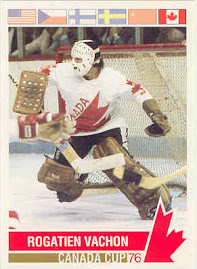
Rogie Vachon

Rogatien Vachon is another NHL great sadly not recognized by the Hall Of Fame. He Canadiens tenure was shorter than what was initially projected for him, and was punctuated by two disappointments - namely the 1967 playoff final loss to Toronto and the missed playoffs of 1970.
When my own interest in hockey was sparked at age 8, I always identified with the goaltender first. I was the goalie in street hockey games and in my mind that was what I thought of being in my NHL dreams. My mother had sown Rogie's number 29 ( one of several numbers he'd wear ), cut out from a pillowcase, onto my Canadiens sweater.
I was always Rogie when I played in the street.
Coincidentally, when Ken Dryden bumped Vachon from the Habs crease hierarchy, the 29 remained as Rogie's number in my heart, even though he wore 30 from then on.
Vachon joined the Montreal Canadiens in 1966-67 to back up Gump Worsley and ended up playing the majority of their playoff games when they reached the Stanley Cup finals. Toronto won the Cup, but the diminutive Vachon earned a permanent place in the big league with his excellent play.
In 1967-68 Vachon excelled in 39 regular season contests and shared the Vezina Trophy with teammate Gump Worsley. Their goals against mark of 2.26 was the league's best since 1958-59. His play contributed significantly to Montreal's consecutive Stanley Cup championships in 1968 and 1969. After Worsley suffered a nervous breakdown and moved out of Montreal, Vachon inherited the starting job in the Montreal net. He played well in 1969-70 but the defending champions failed to make the playoffs.
The Canadiens confidence in Vachon as a goalie who could take on the majority of the season's games was invariably shook when he encountered in juryproblems in the early 1970's. His inconsistant play opened the door for Dryden's arrival and Vachon was not comfortable or able to contribute in a secondary role. In 1971-72 Vachon requested a trade after he allowing four goals in his only period of action with Montreal that season.
Vachon was given a new lease on life when the Los Angeles Kings acquired his services in November 1971. and he went on to enjoy some of his finest seasons and helped the Kings become a competitive hockey club. He recorded 32 of his 51 career shutouts in Los Angeles and he was twice selected to the NHL's second All Star team.
In Los Angeles, Vachon and Marcel Dionne became the most popular figure in franchise history and he was selected the team's most valuable player four times in five years between 1973 and 1977.
As Vachon had become so identified with the Kings, his contribution as the backstopper to two of the Canadiens Cups during what seemed transional seasons has lessened his claim as a great Habs goalie.
Nonetheless, it remains a slight that he is not in the Hockey Hall of Fame. He is the most winning goalie of the 1970's not so enshrined and was one of the final Original Six era players, along with Wayne Cashman, to still play into the mid 1980's.
Jimmy Roberts

In the 1960's and 1970's, Jimmy Roberts was a key cog for the Habs, rarely in the limelight, but always an essential ingredient to the teams composition. He was a defensive specialist by definition, killing penalties and shutting down opposition lines to great effect. His intuition for positional poise, and his composure in the heat of the action, made him the ideal candidate to fill in as a defenseman when the Canadiens needed depth at that position. Through two tenures with the team, he became the Canadiens man for all seasons, often thriving at being an unfettered thorn in the opposition's sides.
Roberts had an enthusiam for the dirty work roles of an underdog. Hitting the ice an alert and intense competitor, part of the fun of watching Roberts irritate opponants had alot to do with watching his focused stare burst into a disbelieving grin whenever he or a linemate scored.
Roberts was never the most talented prospect, but was fortunate to come under the tutelage of a young Scotty Bowman with the Peterborough Petes in the late 1950's. He listened intently and learned the inner workings of the game within the game and the lessons inherited served him well.
Roberts gradually climbed the echelons of the Canadiens minor team structure for five seasons, getting closer to his goal in each passing year. From the Petes, he moved on to play with the Montreal Royals, the Hull Ottawa Canadiens, the Cleveland Barons, the Quebec Aces, and the Omaha Knights before getting an NHL break. Throughout his ascention, Roberts was hardly ever a team star, while perfecting his endeavor as a role player par excellence.
Roberts established himself as what Toronto Maple Leafs GM Conn Smythe once described as "a hewer of wood and a hauler of water." Roberts was once termed as being "built like a mooring post for a battleship." Roberts won 5 Stanley Cups with the Canadiens, and appeared in three consecutive finals with St. Louis from 1968 to 1970 with Bowman as his coach. He parlayed his dedication into a long career that led to coaching after his retirement.
Mario Tremblay

Mario Tremblay was part of a tag team youth invasion to the Habs in the mid 1970's when he and Doug Risebrough were brought into the Habs machine to provide an unsettling effect to opponants with their tireless work ethic.
Tremblay in many ways, was a hotheaded yapper who could score, check, hit, and get under the skin of opponents. With Risebrough and Yvon Lambert, the trio soon became the NHL's most feared and best third line and were key ingredients in the Canadiens four straight Cups wins from 1976 to 1979. Tremblay was credited with the Cup winning goal in the tightest of their 4 Cup defenses, in game 6 of the 1978 finals against the Boston Bruins.
The feisty Tremblay continued to be a force in Montreal after the Cup dynasty ended and he recorded consecutive 30 goal seasons in the early 1980s while playing on a line with Rejean Houle and Pierre Mondou. In 1984-85, he scored 31 goals, including 14 with the extra man. Tremblay played 56 games the following year, but injuries prevented him from being apart of the 1986 Stanley Cup.
While Tremblay was always a warrior who wore the Habs crest close to his heart, it is unfortunate that his player's legacy will always be tainted by the confrontation that he had as Canadiens coach that resulted in Patrick Roy's exile from Montreal.
Craig Ludwig

Defenceman Craig Ludwig was a solid player in his own end and a punishing hitter during his eight seasons with the Canadiens. His experience and savvy were an important factor on both the 1986 Habs Cup and 1999 Dallas Stanley Cup winning teams.
Ludwig's role with Montreal was to solidly anchor the play of more offensive types by providing positional consistency and rugged play. Teamed often with either of Larry Robinson or Chris Chelios, Ludwig made choosing his side of the Habs end a bruising one. Not only did Ludwig hit with authority, he was badass nasty when it came to sending messages to opponants with high sticks, elbows, and scratchy gloves in players faces.
Ludwig understood his role perfectly and always played within his means. He was an adept first passer, a feared pugilist seldom tested, and a shot blocker with few peers. This steady assault of workmanlike attributes were big factors when Montreal reached the semi finals in 1984, won the Stanley Cup in 1986, and reached the finals again in 1989.
Mike Keane

I recall how, when Mike Keane made the Canadiens from training camp in 1988, that Habs coach Pat Burns was practically vilified in the media for the promotion.
Burns evidently knew something about Keane that the Montreal press did not, and it didn't take long for Keane's worth to show itself. hardly an offensive threat, Keane demonstrated leadership from the get - go with head first play and an unabashed enthusiam for mixing it up. His scrappy essentials and unselfish giving of his every pound translated itself to teammates conciences, and Keane was no stranger to speaking loudly when those around him took the easy route.
The feisty Keane was signed as a free agent by Montreal just before start of 1985-86 season and he scored 68 points in 78 games during his first pro season in Sherbrooke. Burns loved his aggresive style and brought him up to the NHL in 1988-89. He scored 16 goals as a rookie and immediatly impressed with his robust play. He added another four goals in the playoffs to help Montreal reach the final, a series they eventually lost to the Calgary Flames. Keane's best year was 1992-93 when he scored 60 points and scored 15 points in 19 post-season games as Montreal won the Stanley Cup.
He remained one of the Canadiens most consistent players and was named team captain after Kirk Muller was traded to the New York Islanders in 1995. As the first two months of the 1995-96 season were turmoil filled in Montreal, Keane was unappreciatively tossed into the Patrick Roy trade.
It equalled a giant sucking out of dressing room leadership for the Canadiens, whose brass was intent on ridding themselves of an unconventional English speaking captain.
Keane's worth was again on display when the Avalanche won the Cup following the deal. As Conn Smyther winner Joe Sakic was asked about Roy's contribution, he stated that the unequivocal dressing room leader had surprisingly been Keane.
Keane would win another Cup in Dallas, forming the "Grumpy Old Men" line with former Habs dethroned captains Muller and Carbonneau.
There's an obvious lesson for all to ponder.
Vincent Damphousse

On August 27, 1992, when Vincent Damphousse was traded to the Montreal Canadiens, they aquired the big centreman that had lacked since Bobby Smith. Playing in his home town, Damphousse was primed and motivated, and he responded with 39 goals and 58 assists. He was even more keyed in the 1993 playoffs, and responded with 23 points in 20 games as the Canadiens won the Stanley Cup.
A large center, who was diffecult to budge from the puck, Damphousse gave the Canadiens great strength down the middle when added to the likes of Guy Carbonneau and Kirk Muller. He was a consistant point per game player for the Canadiens for five of his seven seasons there.
Named captain in 1996, his role slowly evolved with the team, and he was groomed into a savvy two way defensive specialist. As consumed as he was with fulfilling his roles and duties, the timing of the change in play philosophies could not have been worse. Saddled with a hefty contract as his production declined on a team whose woes were just beginning, Damphousse was often blamed for the team's shortcomings.
In 1999, as he was pursuing a long term deal with the team, issues came to a boil with coach Alain Vigneault. While the team felt there was not enough upside left in Damphousse's game, the player wished to prove otherwise. The Canadiens then shipped their last Quebec born captain to the Sharks for draft choices that never panned out. The move was ill advised, as Damphousse could surely have contributed another five solid seasons and retired a Montreal Canadien.
Doug Gilmour

Doug Gilmour is one of my all time favorite players. His competitiveness and his ability to leave his all on the ice each night, made him a favorite of mine going all the way back to the days when he played in my hometown with the Cornwall Royals.
I've always felt that Gilmour had in his eyes, the same piercing glare of "go through the boards insanity" that was perhaps only surpassed by Rocket Richard and Mark Messier.
"Killer" was in Cornwall in the summer of 1999 to visit old friends when he told me of his curiosity in finishing his career in either a Habs or Senators uniform. The words rang in my ears for three seasons.
Gilmour finally arrived in Montreal towards the end of a glorious career. Many doubted that he had much fire in the tank and he was not perceived as a savior of any kind by that time.
Signed shortly after the season started for his leadership abilities, in light of Saku Koivu's season long absense from stomach cancer, Gilmour brought the team together with an inspired brew of guts and a hatred for losing.
In his first game as a Hab, Gilmour went after the Sabres Miroslav Satan, when the Buffalo player took liberties with an unsuspecting Canadiens player. It was a gesture that earned Gilmour a one game suspension, and the respect of his new teammates.
It took some time for Gilmour to find his legs and his game that year, but once he did, he rallied the team in it's goal of a playoff spot. With Koivu's return as an inspiration, and Jose Theodore imitating God in goal, Gilmour was a captain without the "C" as the team fought on bravely.
"Killer" made several references to the on ice plight the Habs were involved in being nothing compared to Koivu's fight off ice and the team responded positively. He backed up his words with the promise that if Koivu were able to return for the post season, the Canadiens would meet him there.
Led by Gilmour's fiery play, the Canadiens met their goal. Koivu's late season return, combined with the subsequent upsetting of the first place Bruins, turned what looked to be a disastrous season into a testament of the values of character, desire and belief.
Gilmour wasn't quite the same sparkplug the following season as both Theodore and the Canadiens as a whole took a step back.
My numerous Canadiens memories encompass the events and seasons that include 9 Stanley Cup victories - from 1969 to the present. In all those years I have seen many feats worthy of retelling and watching Gilmour and Koivu channel spirit from each other in 2002 will be a long cherished favorite.
Robert L Note: This being my last post of 2007, I want to wish all my readers all the best in 2008.
Unbelievably, this little hobby site of mine garnered over 120,000 hits in 2007, more than 80,000 of which came since last June. In the coming year, and I am certain of this, our Canadiens will provide us fans with even more to be cheerful for, and God willing, I will be around to blog about it for you.
I cannot put into words what you all, my readers, have meant to me during this past year. I have felt every kind word of appreciation from the lot of you for what it is I do here. Eighteen months into this project, I am still juiced when I receive a comment or e-mail that says " I love your blog", "I'm a longtime reader", and "Keep up the good work".
I take all those words straight to heart. I sincerely hope that my own appreciation of you tuning in comes through.
As this site chronicles the Habs destiny towards it's next Stanley, my New Years wish for all of you ties into the Habs successes on many fronts. May those of you who have been handed down your Habs love from a fanatic hockey parent, cherish together another Cup win. For those of you who have seen and lived through the glory days and are sickening your sons and daughters to no end with tales of how it once was, may you soon able to share in the glory of the present tense together.
I would fit into both these categories folks, and I know exactly what you would be feeling!
Beyond the daily life distractions that hockey offers us in coping with life as a whole, I wish you all the health and prosperity you can handle. I extend to you the same New Years resolution I renew within myself each passing year - Let's all be good to each other, damnit!
On another note - again directed to regular readers - a new computer will be entering this household in the first week of the new year, and it may cause some latent chronicling of the team. It's been a hellish month dealing with an outdated system and a myriad of issues too long to get into. That combined with a slew of 3 to 11 shifts at work have made this December a thin month here for posts and after game reads - my apologies.
New years equal new beginnings, and I can't wait. Thanks in advance for your patience and loyal readership.
Happy New Year!